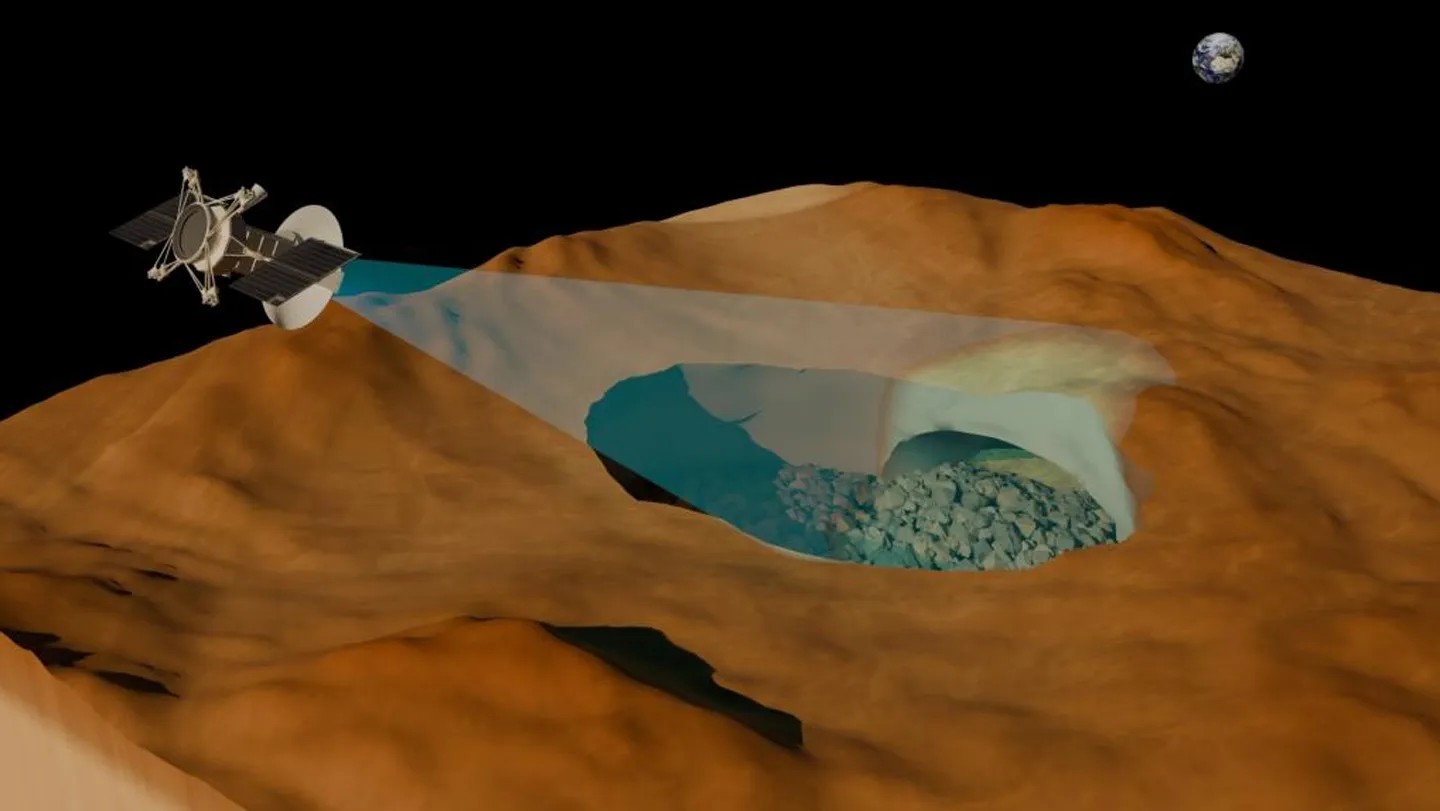
Recent planetary observations have revealed a significant geological feature on Venus: a massive underground lava tube. This discovery provides a rare glimpse into the volcanic history of our neighboring planet and offers new insights into how its surface has evolved over billions of years.
The Discovery and the Science
The identification of this structure was made possible through the use of radar imaging. Because Venus is shrouded in a dense, opaque atmosphere, traditional optical telescopes cannot see its surface. Radar technology, which sends radio waves that bounce off the ground to map terrain, allows scientists to “pierce” through the thick clouds to reveal the topography beneath.
The data indicates that this lava tube was formed by ancient volcanic activity. In such processes, molten rock (lava) flows through channels in the planet’s crust; as the outer edges of the flow cool and solidify, they create hollow, tube-like structures that remain even after the liquid rock has drained away.
Why This Matters for Planetary Science
The presence of large-scale lava tubes on Venus is more than just a geological curiosity; it is a vital clue to understanding plate tectonics —or the lack thereof—on the planet.
- Geological Context: On Earth, plate tectonics constantly reshape the surface. On Venus, the geological activity appears to be driven by different mechanisms, likely involving massive volcanic eruptions and the movement of molten rock beneath the crust.
- Surface Evolution: Large lava tubes suggest that Venus once experienced sustained, widespread volcanic flows. Mapping these features helps scientists reconstruct how the planet’s crust has moved and changed over time.
- Extreme Environments: Studying these structures helps researchers understand how geological features can survive the planet’s incredibly harsh conditions, including a surface temperature of 460°C (860°F) and an atmospheric pressure 100 times greater than Earth’s.
Looking Ahead
This finding underscores the importance of continued radar exploration. As space agencies like NASA look toward future missions, understanding the subsurface architecture of Venus will be critical. These underground voids may hold the key to understanding the planet’s thermal history and the processes that govern its violent, volcanic landscape.
The discovery of massive lava tubes suggests that Venus possesses a complex, dynamic interior that continues to shape its surface in ways we are only beginning to understand.
In summary, the detection of a massive lava tube via radar provides essential evidence of Venus’s volcanic past and offers a new way to study the planet’s unique geological evolution despite its hostile environment.