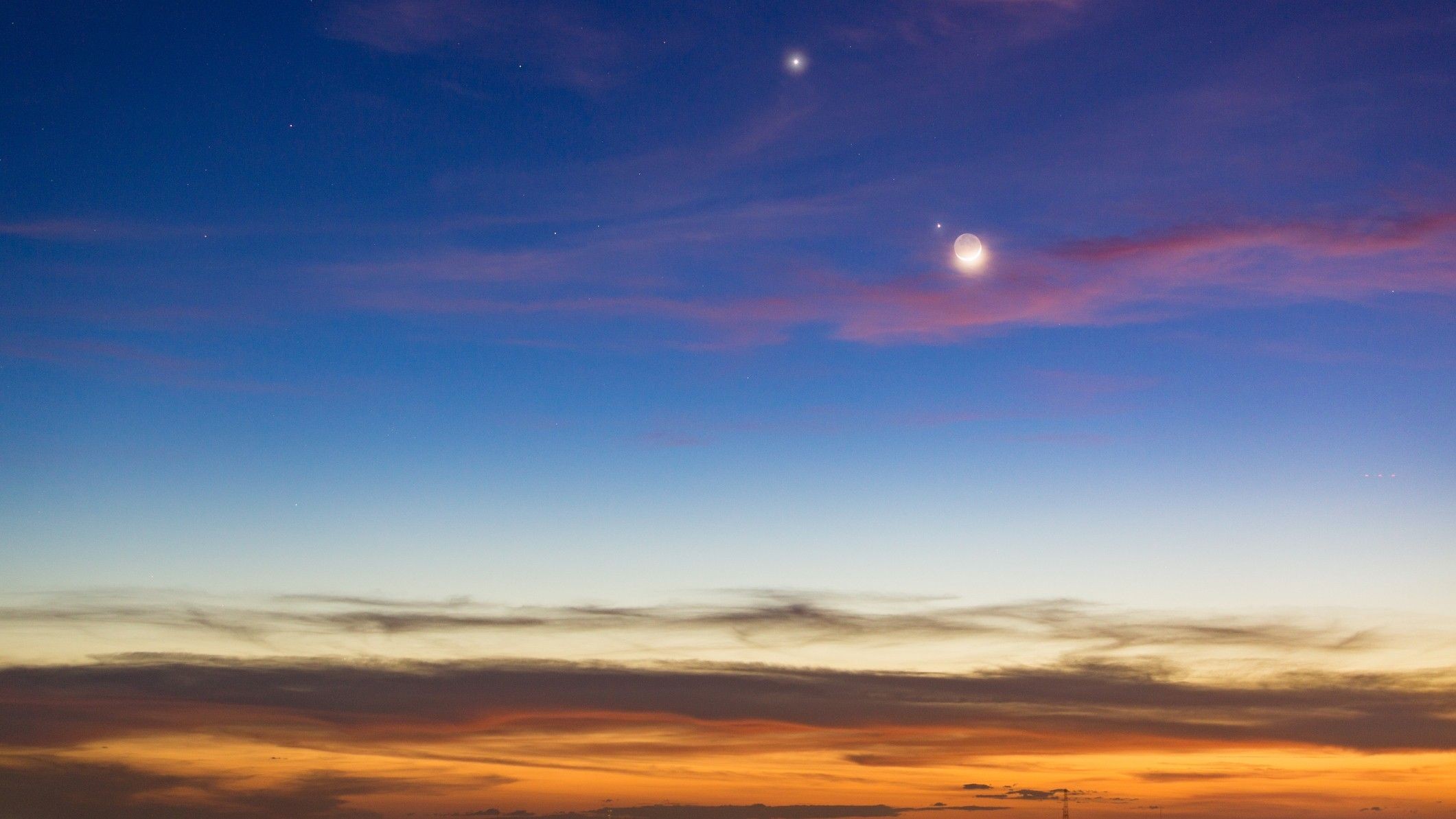
On the evening of Wednesday, April 22, stargazers have a prime opportunity to witness a spectacular alignment in the night sky. As twilight fades, the Moon and the planet Jupiter will appear in close proximity, creating a visually striking “rendezvous” in the western sky.
How to View the Event
If weather conditions allow for clear skies, you can catch this display roughly 45 minutes after sunset. Look toward the western horizon; the duo will be positioned about two-thirds of the way up toward the zenith (the point directly overhead).
To help visualize the distance between these two bright objects:
– The Moon will be roughly 3 degrees away from Jupiter.
– For a practical reference, if you hold your clenched fist at arm’s length, it covers about 10 degrees. The gap between the Moon and Jupiter will appear to be approximately one-third of a fist.
At the time of this event, the Moon will be in its waxing crescent phase, approximately 38% illuminated.
The Brightest Players in the Sky
Even without the Moon’s company, Jupiter is a dominant force in the night sky. With a magnitude of -2.1, it is the brightest object visible after Venus and the Moon. It will remain high in the sky until its setting around 1:35 a.m. local time, acting as a bright beacon throughout the evening.
Adding to the visual drama are the stars of the Gemini constellation. The bright stars Castor and Pollux will appear positioned above the celestial duo:
– Pollux (yellowish) will be about 9 degrees above Jupiter.
– Castor (white) will be roughly 6.5 degrees above the Moon.
As noted by astronomer H.A. Rey, the combination of the Moon, a planet, and the Gemini twins creates one of the most impressive shows available to the naked eye.
Deep Sky Observations: Telescopes and Binoculars
For those using optical aids like binoculars or telescopes, the experience shifts from a beautiful silhouette to a detailed study of planetary physics.
Observing Jupiter
While Jupiter appears slightly smaller now than it did during its opposition in January, it remains a magnificent target. The quality of your view will depend heavily on “atmospheric seeing”—the stability of the air—rather than just the magnification of your lens.
The Galilean Moons
One of the most rewarding aspects of observing Jupiter is watching its four largest moons (the Galilean satellites). Even with modest binoculars, you can spot several of them:
– Io: Located closest to the planet.
– Callisto and Ganymede: Flanking the planet at greater distances.
Timing for Eclipse Observers:
If you are tracking the moons’ movements, take note of these specific timings (EDT):
– 10:39 p.m.: Io will disappear behind Jupiter.
– 11:36 p.m.: Europa will emerge from Jupiter’s shadow.
Watching these moons is a lesson in celestial mechanics; because they are massive bodies, they appear as tiny “stars” that constantly shift their positions relative to Jupiter and each other.
Summary: This Wednesday evening offers a rare, high-visibility alignment of the Moon, Jupiter, and the Gemini twins, providing both casual observers and amateur astronomers a perfect opportunity to witness planetary motion and lunar phases in action.