The sun won’t explode. It won’t go bang.
Instead, it swells. Red giant style, engulfing the inner planets. Mercury, Venus, Earth? Gone.
Or maybe not Earth entirely, but definitely cooked.
But what about the outer edges?
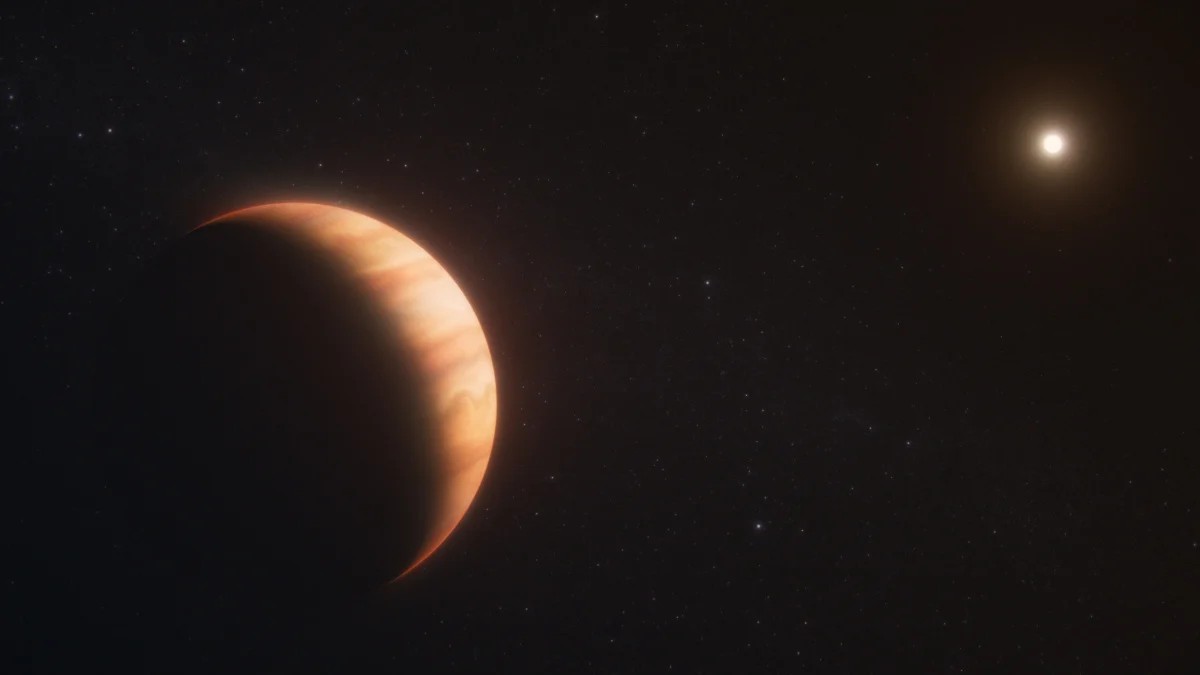
Researchers have just looked at a white dwarf 80 light-years away and found a planet orbiting it.
WD 1856b.
It’s massive. Heavy. A giant gas bag with an atmosphere thick in methane and haze.
We usually look back with telescopes. Deep space is ancient history.
This is different.
“We’re used to looking back in time,” said Ryan J. MacDonald from St Andrews, “but this is the first time we are looking forward.”
It’s a time machine for the future of our own solar system.
Heat from Nothing
Here’s the weird part.
The planet should be frozen.
Its star is a white dwarf, a husk. No fusion, just cooling ash.
Logic says WD 1856b should be cold enough to shatter stone.
It isn’t.
It’s about 250 Fahrenheit. Hot enough to boil water if you put it in a pan, basically.
How?
It didn’t start here.
Billions of years after the star died, the planet drifted inward.
It tightened its orbit.
As it got closer, the dead star’s gravity grabbed it. Squeezed it. Flexed its core.
That friction heated it up.
Christopher O’Connor, an astrophysicist at Northwestern, calls it “one of the most bizarre planetary systems we have.”
And he’s not exaggerating.
The planet is huge, 4 to 11 times Jupiter’s mass. The dead star is tiny, closer to Earth’s size.
The planet is wider than the star it orbits.
Its year lasts less than two Earth days.
Imagine circling your sun that fast while it shrinks to marble size.
Does the scale feel wrong?
Not a Supernova
Most stars don’t supernova.
They just fizzle out.
They swell first. 100 to 1000 times their normal size. They eat their neighbors.
Then they shed the layers. Leave a core. The white dwarf.
We know Earth gets eaten in that red giant phase.
But maybe Uranus survives? Maybe Neptune?
If they survive, do they just hang out?
No.
This study shows they can migrate. They can reshape their lives after the party is over.
WD 1856’s system is actually a triple system. Two other stars hang around.
Their gravity might have nudged this planet inward three to five billion years late.
Waited it out. Let the star cool. Then moved in.
Why now? Why then?
The data from James Webb gives the first detailed look at this kind of atmosphere.
Methane. Haze.
We still don’t know what the haze is made of, but it’s there.
“Our results show that stellar death is not,” says MacDonald, “the end. Some planets experience a vibrant and lively after death of their star.”
So what does this mean?
Habitable zones aren’t fixed. They don’t vanish when the sun dies.
They can reopen. Long after everyone else has turned to dust.
It suggests places for life where we never expected any.
Ghost worlds waking up in the dark.
We will keep looking with Webb.
Search for others.
Maybe our distant cousins survived in the Kuiper belt. Maybe they drifted inward too.
What waits for them in the silence?
Maybe just heat.
Or maybe more. 🪐