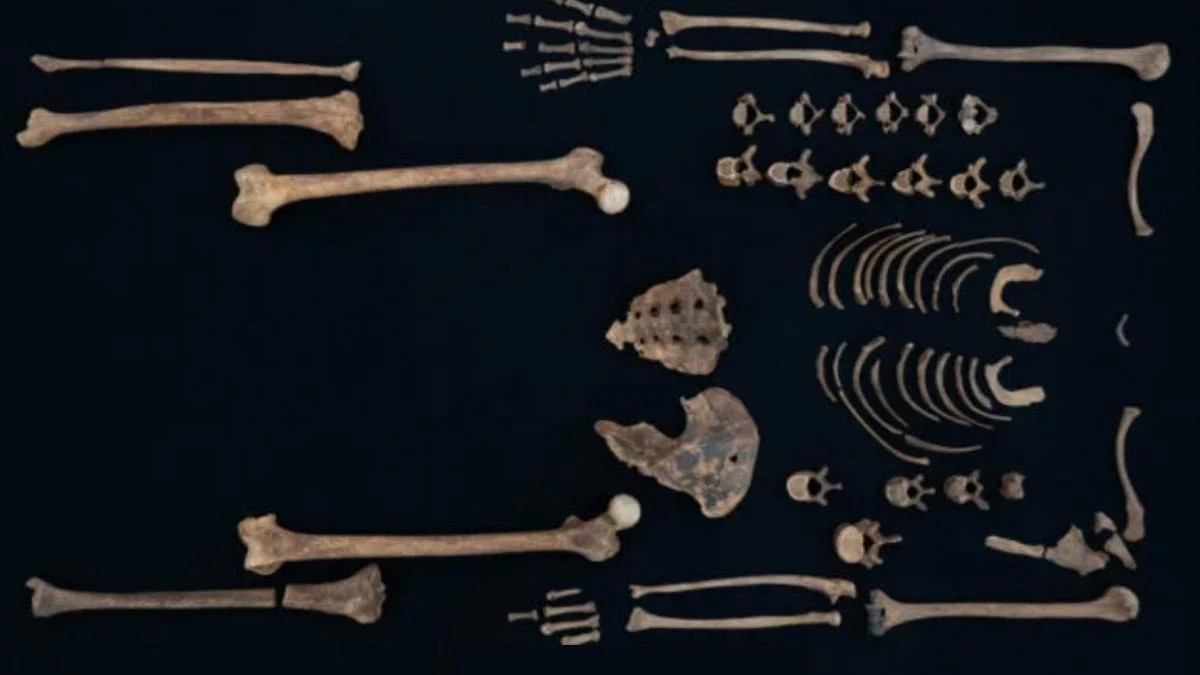
Old stories say ancient royals lived in soft luxury. Bones say otherwise.
A new study just proved it. Ancient Egyptian princesses knew how to handle the weapons buried with them. Daggers. Bows. Maces. They didn’t just pose with them for photos in the afterlife.
They actually used them.
The evidence comes from a dusty box. Literally.
Back in the 1890s, during the peak of the Egyptomania fever, French archaeologist Jacques de Morgan found these bodies at the Dahshur pyramid complex. Four thousand years old. King Hor. Princess Noub-Hotep. A whole court of high-status dead folks.
In 1915 they moved everything to the Egyptian Museum in Tahrirq. Then they stuffed them in a wooden crate and forgot.
“Early curators at the Egyptian museum given the whole box only one number… described it as ‘human remains’.”
For 130 years, they sat there.
That is until 2020.
Zeinab Hashesh, an archaeology professor at Beni-Suef University, remembered the box. She pulled it out. Inside were King Hor, Princesses Noub-Hotep, Itaweret, Khenmet, and Ita, plus one unknown female.
Their skulls are missing though. Gone since 1906. Sent to a medical school for study, then vanished into history. Without skulls, you can’t get the full picture. But Hashesh didn’t let that stop her. She looked at the bones. X-rayed them. Read the history written in calcium.
The results? Surprising.
For decades, scholars shrugged off the weapons in these tombs. They called them symbolic. Votive tokens. Things you leave for a show because men’s jobs are scary. French Egyptologists were confused in 1894 because why would girls need maces? We’re still confused, but we have a better answer now.
Hashesh looked at muscle attachments. Those bony bumps where muscles grab on tell a story of repetition. Intensity. Habit.
Princess Noub-Hotep and King Hor both show robust attachments on their upper arms. The kind you get from pulling a bowstring every single day.
“We found pronounced development… which correlates to repetitive, high-intensive actions.”
Not a weekend hobby. A career.
Princess Ita. Late twenties or thirties. Built strong for maces or daggers.
Princess Itaweret. Broken ribs. Fractured foot. Still shot arrows. Her bones scream archer.
Princess Khenmet. Older. Thinning bones, but her ligaments are tough as leather.
These women weren’t sedentary. They weren’t waiting around for their husbands.
Was this about power? Sure. But it was also about theology.
Ancient Egyptians believed in a specific kind of survival. Your spiritual body needed strength to last. The princesses held the title mesu-nisut. King’s Children. Their job was to keep the divine king’s cycle spinning. Ritual regeneration requires a certain type of engine.
You can’t run the machine on empty. Or on perfume.
“Far from leading sedentary lines of luxury, they were well-conditionned athletes.”
They didn’t imitate men. They did what the royal blood demanded. Disciplined. Powerful. Capable of force.
We often assume the past was soft for the rich. We assume the archives tell the whole truth. They don’t. The truth was in the basement. In a mislabeled box.
We are only just starting to read the footnotes of history.