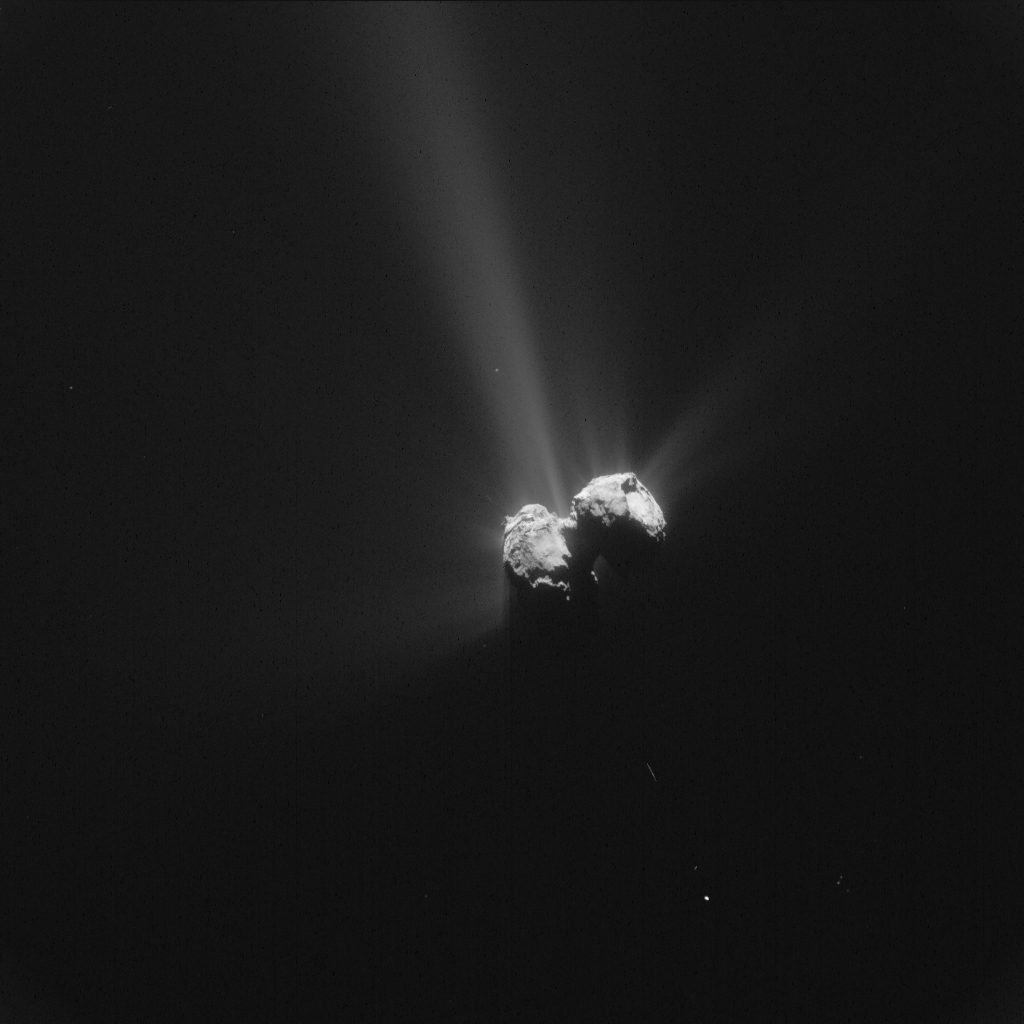
It has been exactly five years since the European Space Agency’s Rosetta spacecraft finally reached its target. After a decade-long journey through the void, the probe arrived at comet 67P/Churyumov–Gerasimenko. The space community still calls it “Tchouri.”
The naming wasn’t arbitrary. Like the Rosetta Stone that unlocked Egyptian hieroglyphs, this mission was designed to decipher the mysteries of the early solar system. The goal was ambitious. Scientists wanted to find out where Earth’s water came from. They wanted to understand the ingredients for life itself.
The mission relied on two components working in tandem. There was Rosetta, the orbiter, and Philae, the small lander robot. Philae bounced across the comet’s surface before finally anchoring itself. It operated for only a few hours. But those hours yielded critical data.
Rosetta stayed behind. For two years, the spacecraft did not leave the comet’s side. It followed the object as it approached the Sun. This proximity allowed scientists to observe the comet’s transformation in real time. They watched the ice turn to gas. They saw dust erupt into space. They tracked changes in the landscape as the heat intensified.
Never before had a comet been viewed with such detail. The images revealed a rugged, uneven body with stark contrasts in terrain.
“The treasure trove includes thousands of measurements and more than 400,000 images.”
Even though the mission ended in 2016, the work continues. Three years post-mission, researchers are still analyzing the data. The collection is massive. It is public. Anyone can explore it.
Visitors to the ESA database can navigate the comet’s surface. The experience mimics flight, hovering just meters above the rock. It mirrors the cinematic journey found in Christian Stangl’s video project, The Comet.
Why does this matter today? Because those 400,000 images are not just pretty pictures. They are historical records of a pristine object from the solar system’s birth. Every measurement helps refine our models of planetary formation. Every gas cloud analyzed adds a piece to the puzzle of our origins.
The data remains available. The questions are still being asked. The answers are waiting in the static.
The news cycle doesn’t wait. Neither should you.
If you missed the last update, catch up now. But don’t stop there. The landscape shifts daily. One minute, a lab in Zurich announces a breakthrough. The next, a startup in Bengaluru prototypes a chip that defies physics. You need to stay plugged in.
Here’s how to keep your feed sharp without the noise.
WhatsApp for instant alerts
Telegram and Signal have their fans. But WhatsApp? It’s everywhere. It’s on your phone. You check it. Every ten minutes. Probably more.
Subscribe to a curated science channel. Not the spammy ones. The ones that verify sources. When a paper hits Nature or Science, you get the headline. You get the link. You don’t have to dig.
It’s low friction. High yield.
Google News for structured discovery
Not everything is breaking news. Sometimes it’s a trend. A shift in policy. A new tool release.
Google News handles this. It aggregates. It filters by relevance. You can pin topics like “quantum computing” or “CRISPR therapies.” The algorithm learns what you care about. It serves you the signal, not the static.
Set it to notify you only for major developments. Otherwise, you’ll drown in minutiae.
Why this matters
Science is no longer locked behind paywalls or academic jargon. It’s democratized. But it’s also fragmented. Misinformation spreads faster than peer review.
You need a reliable pipeline. One that respects your time. One that prioritizes accuracy over virality.
This isn’t about being a scientist. It’s about being informed. The technology you use tomorrow depends on the discoveries you read about today.
Stay curious. Stay updated.