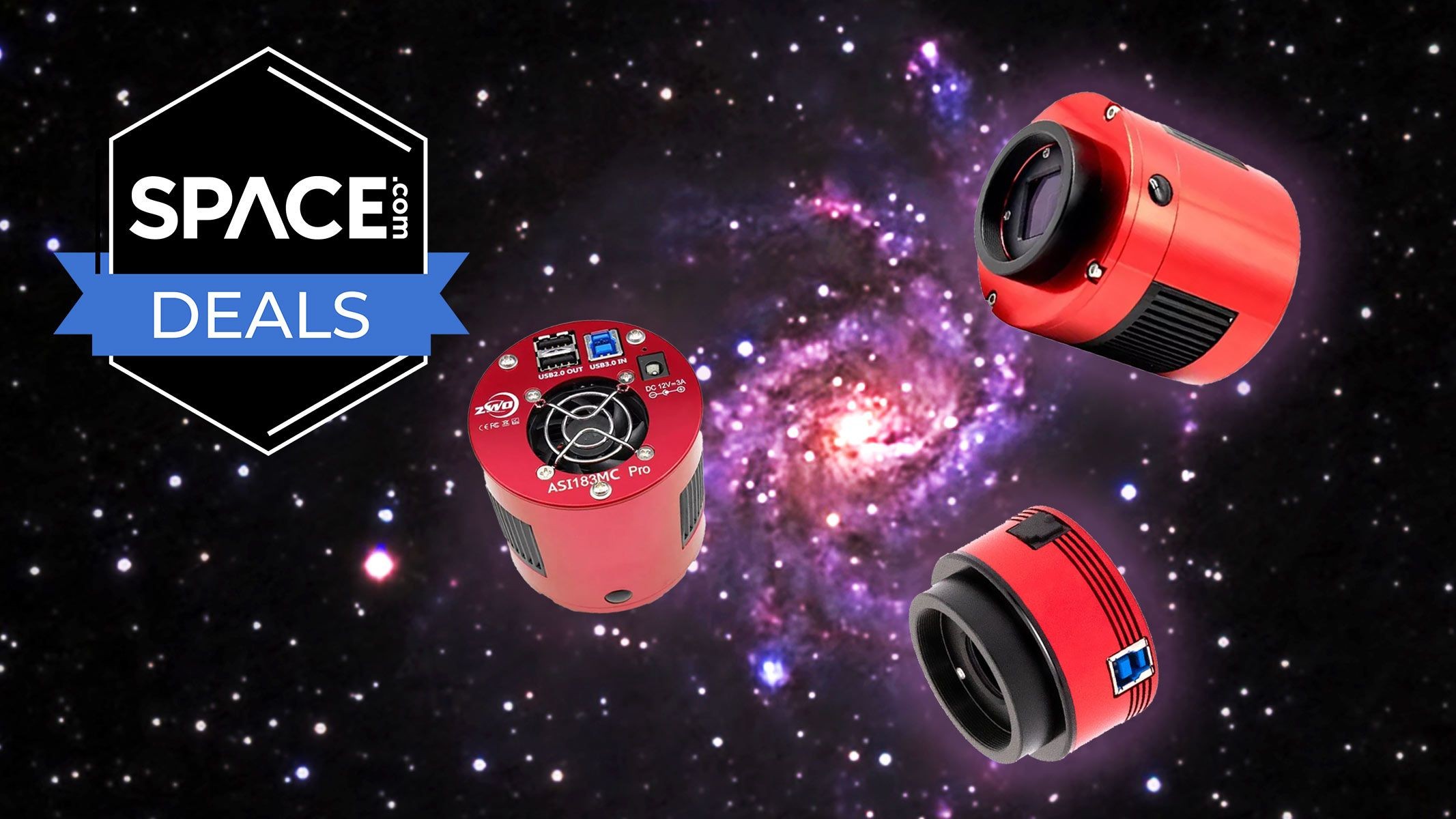
ZWO makes a name for itself with the Seestar smart telescope. It’s accessible. It’s fun. But if you are looking for the heavy lifting—the kind that turns a backyard scope into a deep-space factory—they make dedicated astrocameras. These aren’t toy accessories. They are precision instruments.
We have tested three of their top models. The results are distinct.
The color sensors, specifically the ZWO ASI183MC Pro and the ZWO ASI533MC Pro, pull color out of nebulas with striking clarity. Meanwhile, the monochrome ASI175 (note: the deal lists ASI174, but our review confirms the 175mm was tested for exceptional solar detail) dominates in high-contrast planetary and solar work.
B&H Photo and Video currently has these dedicated astronomy cameras on sale. You are looking at a 10% discount across the board. Here is why you should care, and which one fits your specific night-sky goals.
What actually makes an astronomy camera different?
Forget everything you know about consumer DSLRs or mirrorless bodies. An astronomy camera has a single, obsessive mandate: capture photons efficiently.
It is essentially a naked sensor packed with specialized features. Standard cameras have infrared (IR) cut filters. These block certain wavelengths. Astro cams remove them. This lets Hydrogen-alpha light into the sensor. That is the red glow of nebulae. Without it, you are missing the most vibrant parts of the cosmos.
There is also active cooling. Standard sensors get noisy when they heat up. Noise ruins long exposures. These cameras chill their sensors. The result is cleaner data. Less noise. Higher signal-to-noise ratio.
To use one, you need optics. A telescope or a specialized astrophotography scope is non-negotiable. This hardware works in tandem with your laptop. You control everything from a desk chair.
The Best Color Option: ZWO ASI183MC Pro
Price: $719 (Save $80 from the original $799)
If you want deep-sky color without breaking the bank, this is the entry point. It features a large CMOS chip. It has active cooling. And it comes with a bundle of accessories that make mounting to a telescope straightforward.
We rated it four-and-a-half stars in our review. Professional astrophotographer Damian Peach put it through the wringer. He targeted the Orion Nebula (M41). He aimed at galaxy NGC 6946. He even tried planets.
The camera handles multi-use well. It is not just for faint galaxies. It can tackle short-exposure lunar and planetary photography, too. But it has a quirk. The older sensor technology can suffer from amp glow. You need to capture dark frames to correct for this. It adds time to your workflow.
“Both the ZWO ASI183MC Pro and ASI533MC Pro are suitable for those looking to get a dedicated, multi-use camera…”
— Damian Peach
The Best Overall: ZWO ASI533MC Pro
Price: $719 (Save $80)
This is the pro’s choice. Why? Newer sensor technology.
The ASI533MC Pro features zero amp glow circuitry. This is a game-changer. It means you can skip the dark frame calibration step. That saves minutes. Hours, even, over a long imaging session. Cleaner workflow. Faster results.
It captures full color. It cools actively. It connects easily. We gave this one a perfect five stars. If you are serious about astrophotography and want the most efficient tool possible, this is where you start.
Best for Solar and Planetary Detail: ZWO ASI174 Mono
Price: $539 (Save $60)
Color is nice. But detail is king.
If you primarily want to shoot the Sun, the Moon, or the planets, go monochrome. A mono camera strips away the Bayer filter. Each pixel captures 100% of available light. No interpolation. No color loss.
Expert Jamie Carter tested this setup using a Sky-Watcher Heliostar. The results were incredible. We are talking about sunspots. Filaments. Prominences. The kind of texture that makes you stare at the monitor for hours.
Mono cameras resolve more detail in high-contrast objects than their color counterparts. Yes, you lose the color straight out of the camera. You add color back in during post-processing. It requires more work. But the clarity is unmatched.
Which ZWO camera should you buy?
The decision comes down to what you are trying to shoot.
- Buy the ASI533MC Pro if you want the best overall performance and don’t want to deal with dark frames. It is the most efficient all-rounder for deep-sky and wide-field imaging.
- Buy the ASI183MC Pro if you are on a tighter budget but still want high-quality color imaging. The amp glow is a manageable hurdle for most users.
- Buy the ASI174 Mono if** your focus is solar, lunar, or planetary work. The resolution gains here are substantial.
These cameras are tools. They require patience. They require a tripod, a mount, and a clear sky. But when the shutter finally closes, the image is worth it.
B&H’s sale doesn’t last forever. And neither does good weather.