It wasn’t hypothermia. It wasn’t strangulation.
For decades, archaeologists assumed the method of death for these three specific Inca children was a simple matter of environmental exposure or manual force. They were wrong. New research reveals that the Capacocha ritual—a cornerstone of Inca state religion—was far more complex than the final moment on a snowy peak. The sacrifice was an extended, multi-stage journey involving diet shifts, mobility across thousands of miles, and a complete reimagining of death as a transformation, not an end.
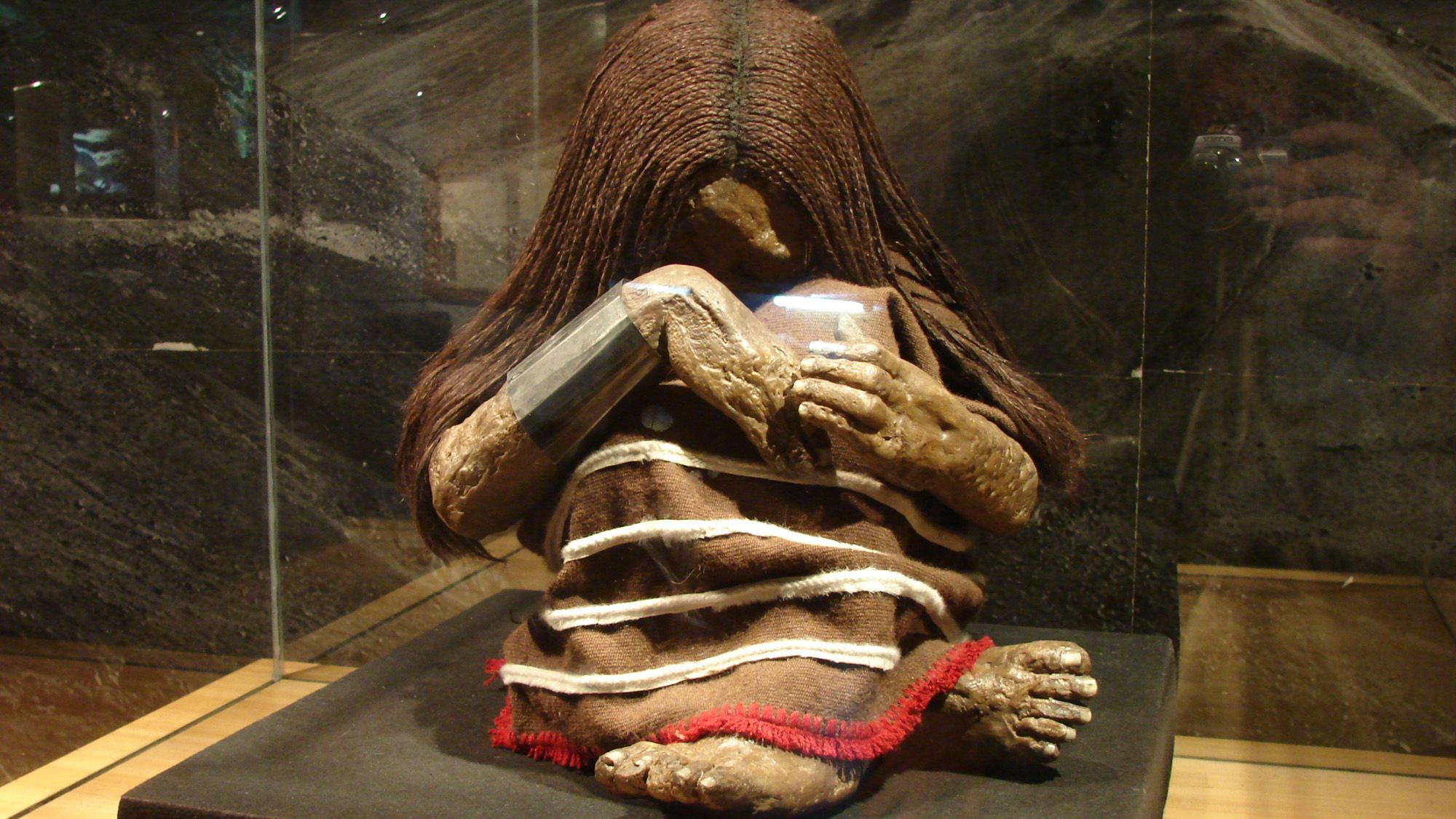
The El Plomo Boy and the Cerro Esmeralda Girls
The subjects of this new analysis are three mummies from the 15th-century Andes. They are familiar to anyone who has visited a museum in Chile: the “Niño de El Plomo,” found in 1954, and the two Cerro Esmeralda girl mummies, discovered in 1976 near the top of what is now Cerro Esmeralda in the Atacama Desert.
Previous assessments held that the El Plomo boy (approx. age 8–9) died from freezing to death on the 17,704-foot summit. The Cerro Esmeralda children (ages 9 and 18) were presumed strangled due to marks on their necks.
A study published July 15 in Science Advances, led by Verónica Silva-Pinto at Diego Portales University, dismantles both assumptions.
Using CT scans and microscopic analysis, the team found that the El Plomo boy sustained blunt force trauma to the head. The fracture was invisible to earlier investigators using less invasive methods. As for the girls, the marks on their necks were not evidence of ligature strangulation. The hyoid bones in their throats were intact—a critical detail. In almost all strangulations, these bones fracture or displace. The marks were likely post-mortem damage from clothing.
The cause of death for the girls is now deemed “indeterminate.”
“Death was not necessarily understood as an absolute ending, but rather as a transformation… The individuals who were offered acquired a new status.”
This forensic correction matters. It forces us to look at the Capacocha not as a single act of killing, but as a “sacred pilgrimage.”
Tracing the Pilgrimage: Isotopes and Distance
How do we know these children walked thousands of miles? The answer lies in their hair.
Silva-Pinto’s team analyzed hydrogen and oxygen isotopes in tiny samples of hair. These elements record the geochemistry of the water and food a person consumes. Since isotopic signatures change depending on the region and altitude, they create a chemical map of movement.
The results were striking. The El Plomo boy traveled between 1,616 and 1,739 miles (2,600–2,800 km) over his last nine months. The Cerro Esmeralda girls moved between 561 and 733 miles (900–1,180 km) in their final months.
Did they start in Cuzco? The study suggests the boy likely did, moving from the imperial heart to the high Andes. The girls’ routes are less clear, possibly starting from other Inca regions. Radiocarbon dating confirms they died in the 15th century: the girls around 1450, the boy around 1480.
These weren’t random acts. They were scheduled events. The Capacocha practice was continuous, connecting outlying provinces with the high sacred sites. Along the routes, local communities participated. They shared food and beverages with the pilgrims. The landscape itself became sacred through this movement.
Debate: Political Tool or Religious Rite?
Not everyone is convinced by the interpretation.
While the forensic findings on the cause of death are strong, the travel narratives invite skepticism. Dagmara Socha, a bioarchaeologist at the University of Warsaw who was not involved in the study, warns against overinterpreting the isotope data.
“Isotopic analyses alone do not allow us the reconstruct the potential route,” Socha said. “Observed isotopic changes may also reflect seasonal variation in diet rather than long-distance travel.”
Furthermore, some archaeologists worry the study leans too heavily into a “top-down” political narrative. Pablo Mignone, from Argentina’s Institute for Research in Social Sciences and Humanities suggests the authors view these children merely as instruments of “biopolitical conquest.”
Mignone argues that Capacocha participants didn’t always come from Cuzco. To treat the capital as the sole engine of these rituals is an “interpretive choice” that the broader evidence doesn’t fully support.
The Ritual Landscape
Regardless of where they started, the Capacocha ritual clearly served to bind the empire together. It wasn’t just about sacrifice. It was about integration.
The children’s bodies were treated as mediators. Between the state and the gods. Between the communities and the mountains. The act of moving them through the empire, changing their diets, and altering their status was the point.
Silva-Pinto notes that Capacocha began months before the final offering. It involved dietary changes. It involved participation from different communities. It turned roads into sacred landscapes.
We used to think these children died alone in the snow or were choked into silence. We were wrong. They died as part of a complex, mobile, and deeply intentional system that defined the Inca worldview.
The technology has changed. Our understanding is changing with it. The mummies on display in Santiago and other museums hold more secrets than we knew. But even with new data, questions remain.
Did they suffer? We still can’t say for sure. Did they walk all the way from the capital? Maybe, maybe not. But one thing is clear. The Inca didn’t just take life. They transformed it.