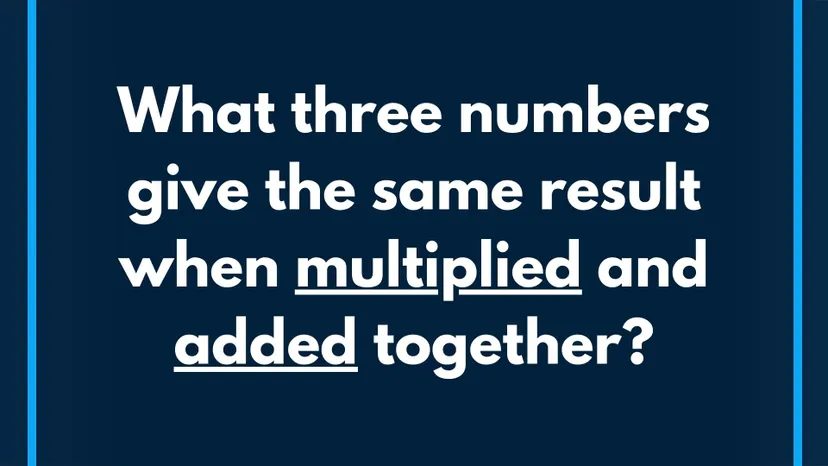
Here is the solution to the classic math riddle. The three numbers you are looking for are 1, 2, and 3.
It works because of a unique mathematical quirk. If you add them together, you get six. If you multiply them, you also get six.
1 + 2 + 3 = 6
1 x 2 x 3 = 6
This specific combination is often used in logic puzzles to test basic arithmetic skills. It is the simplest set of distinct positive integers that satisfies both conditions. Most people overlook it because they start with larger numbers like 2, 2, and 2. But 2 + 2 + 2 equals six, while 2 x 2 x 2 equals eight. That breaks the rule.
The trick is realizing that the number one does not change the product when multiplied, but it does add to the total sum. This allows the multiplication result to stay low while the addition result climbs.
Try changing any of these numbers and the balance falls apart. Use 1, 2, and 4. The sum becomes seven. The product becomes eight. You have moved away from the target.
Keep 1 and 2, but drop the 3 for a 4? Sum is seven. Product is eight.
Stick with 1 and 3, but swap the 2 for a 4? Sum is eight. Product is twelve.
The only stable set for this specific puzzle remains 1, 2, and 3. It is an elegant little loop in arithmetic. Nothing else fits so neatly.