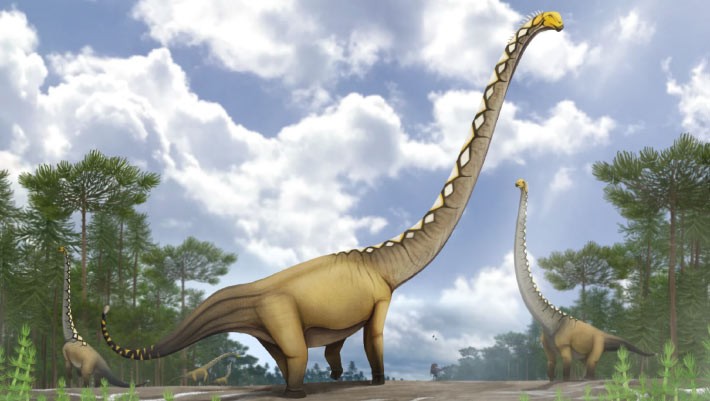
They didn’t think the giants went this far south. Or at least, that’s what we used to assume.
Mamenchisaurids, those bizarre sauropods with necks stretching longer than school buses, were practically Chinese royalty during the Late Jurassic. Uragasaurus kalasinensis changes the map. Paleontologists in northeastern Thailand found one. Well, a piece of it. A single, remarkably preserved dorsal vertebra from just behind the neck. But that one bone is enough to scream Uragasaurus from the cliffs.
It lived 150 to 145 million years ago when what is now Thailand was still part of that sprawling eastern landmass. The rock layers here—the Phu Kradung Formation—are river-deposited sediment. They are old, they are muddy, and they are one of Southeast Asia’s best keeps for Jurassic bones. This find came from a spot called Phu Noi.
The fossil, catalogued as PRC 461 (wait, 460, let’s check—yes, PRC 460 ), sits near other sauropod scraps. Those other bones? They might have come from the same beast, or they might have died hours apart nearby. Nobody knows. But this specific vertebra? It tells a clear story.
It has the tells. High pneumatic structures in the neck vertebrae. That makes them light, aerodynamic in their own heavy way. It places this thing right in the Mamenchisauridae family tree. Not just near it, but close to the base. An early branch. A cousin to the famous Mamenchisaurus but something distinct, something earlier in the lineage.
Why does this matter? Because before this, finds outside China were rare ghosts. Whispers. This is a named species. A formal record. It suggests that the faunal connection between China and mainland Southeast Asia wasn’t broken back then. The dinosaurs moved. They spread. The East Asian landmass was connected enough for these giants to wander across it.
The presence of closely related taxa in China implies they weren’t just neighbors. They were part of the same biological conversation.
The analysis puts Uragasaurus as an early diverging member of the group. That’s interesting. It means the morphological variation—the shapes and sizes and bone structures—was already kicking off early. We thought we understood the phylogeny, the evolutionary position, but mamenchisaurids have always been messy. Their long necks evolved convergently in other lineages like Titanosauria too, which confuses the DNA-like reading of bones.
It’s complicated. But it’s here. In Thailand.
The team, led by Dr. Apirut Nilpanpan of Mahasarakham University, argues that this expands the range. Not just a slight nudge. A real expansion into mainland Southeast Asia. It complicates the biogeographic story. The Late Jurassic wasn’t a closed box.
Did they swim? Did they walk across a bridge of islands we no longer see? The fossil record is too patchy to say for sure. Dispersal routes remain blurred.
We have one good bone. And it changes the geography of the giants. More might come out of the Phu Noi site. Probably. The Jurassic deposits in this part of Asia are deep. And deep means full of secrets waiting for someone to dig them up.