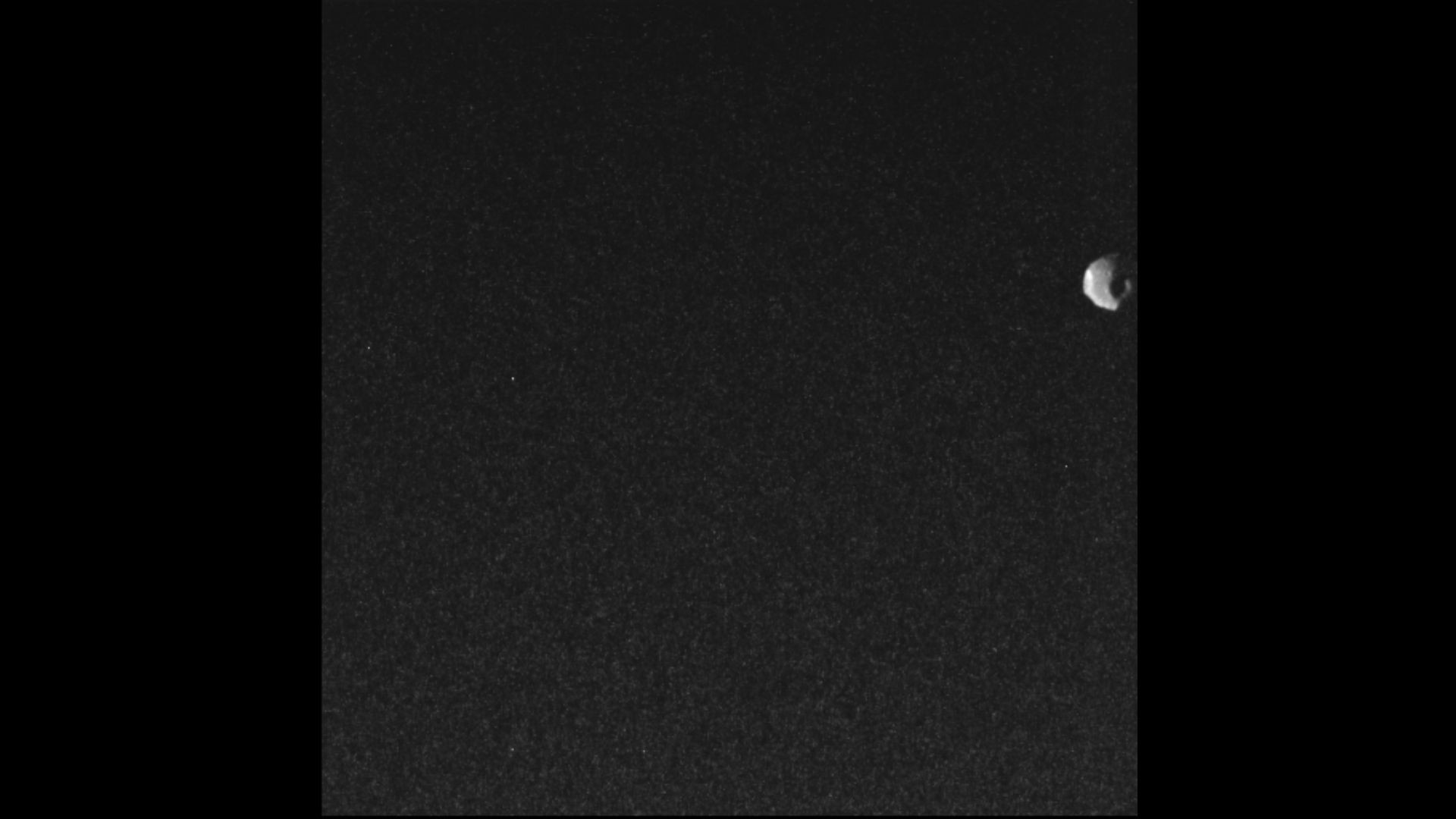
NASA’s Juno spacecraft has provided a stunningly close look at Thebe, one of Jupiter’s largest inner moons. During a flyby on May 1, 2026, the probe passed within just 3,100 miles (5,000 kilometers) of the moon, capturing high-quality imagery that highlights the enduring value of long-duration space missions.
A Glimpse at Jupiter’s Inner System
Thebe is the second-largest of Jupiter’s inner moons, a group of small, irregularly shaped satellites that orbit much closer to the gas giant than the famous Galilean moons (Io, Europa, Ganymede, and Callisto). While the Galilean moons are massive and well-studied, the inner moons remain somewhat mysterious due to their proximity to Jupiter’s intense radiation environment and their smaller size.
Thebe was first discovered in 1980 by NASA’s Voyager 1 spacecraft. However, prior to this recent encounter, detailed close-up imagery of the moon had been scarce. This latest photo fills a significant gap in our visual understanding of Jupiter’s complex satellite system.
The Instrument Behind the Image
What makes this image particularly notable is the instrument used to capture it: the Stellar Reference Unit (SRU).
- Primary Function: The SRU is not a standard camera. It is a navigation tool designed to image star fields, allowing Juno to determine its precise position in space.
- Unexpected Capability: Because the SRU is optimized for low-light conditions to detect faint stars, it is also exceptionally sensitive to dim objects like distant moons.
- The Result: This sensitivity allowed Juno to capture a clear, sharp image of Thebe despite the moon’s relatively low reflectivity and the challenging lighting conditions near Jupiter.
Why This Matters
This photograph underscores a key trend in modern space exploration: mission extension and instrument versatility.
Juno launched in 2011 with a primary mission focused on Jupiter’s atmosphere and magnetic field. After completing that phase in 2021, the spacecraft entered an extended mission phase. Rather than being decommissioned, Juno is now leveraging its robust systems to explore Jupiter’s moons with greater depth.
The successful use of a navigation sensor for scientific imaging demonstrates how engineers and scientists can repurpose existing technology to gain new insights without the cost of launching new instruments. As Juno continues its extended mission, it has already documented phenomena such as Jovian cyclones and volcanic eruptions on Io, proving that older spacecraft can still yield groundbreaking data.
In short: Juno’s close encounter with Thebe highlights how extended missions and adaptable technology allow us to revisit familiar celestial neighbors with fresh eyes, revealing details that were previously out of reach.