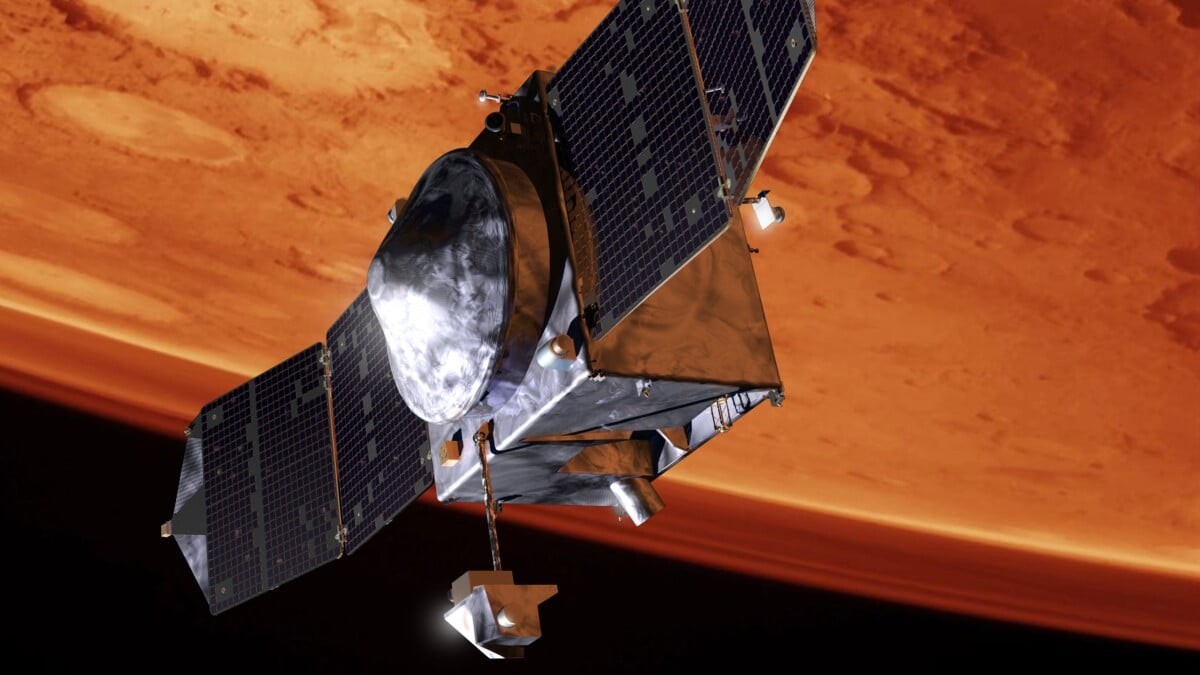
Gone.
That is the status of the MAVEN orbiter. It vanished in December. Not with a bang. Just a slip into shadow and silence.
NASA announced June 3 what they already knew. The spacecraft is unreachable. It has orbited Mars for over 11 years. Longer than planned. Longer than anyone hoped.
On December 6, everything looked normal. MAVEN rounded the far side of the planet. Usually it pops out twenty or thirty minutes later. Chatting away. This time it did not come back. A brief data snippet told the whole sad story. The craft began tumbling. Fast. Then the batteries drained. Nothing to do but say goodbye.
Mike Moreau calls it losing a loved one. Maybe that’s harsh. Maybe it’s true.
“I think the team has really experienced the lost of a loved one…”
What It Actually Did
Science happened here. Good science.
MAVEN tracked atmospheric escape. Basically the slow leak of Mars’ air into the void. The data showed solar storms make the leak worse. Big surges of energy strip away gas.
Take May 2024. A massive space-weather event. The strongest in twenty years. It ripped gas off the planet. Created glowing auroras. Pretty lights, deadly wind.
Shannon Curry, the principal investigator, says we know Mars’ atmospheric loss better than Earth’s now. That’s a bold claim. And likely accurate.
There were other finds too.
– Sputtering : Charged particles hit neutral atoms and knock them out into space. Like a cannonball splashing a pool.
– Dust storms : The 2018 global storm boosted water loss. Tying dust to the death of ancient oceans.
– X-rays : MAVEN picked up signals from the black hole system Scorpius X-1. Unexpected. Useful.
Who knew a Mars orbiter could study black holes?
It helped Perseverance capture visible auroras on the ground too. Now we can imagine what astronauts might see. Not just data. Light.
The Silent Worker
Science is flashy. Communication is boring. MAVEN did both.
It acted as a relay. Hauling data for rovers like Curiosity and Perseverance. It handled about 8% of relay sessions. But 18% of the actual data volume.
Efficient? Yes. Smart? Absolutely. It used a new coding scheme to squeeze more info per contact. At one point it broke the solar system record for single-session data transfer.
Now the network is quieter. Mars Odyssey and other orbiters have shifted schedules to pick up the slack. A new telecommunications network is planned for the 2030s. But that feels very far away.
Where It Ends
MAVEN stays in orbit. Stretched out. Dead weight.
It won’t fall for fifty or maybe one hundred years. Eventually the atmosphere will catch it. Burn it up. No threat to other satellites. No crash risk.
The cause of the tumble remains a mystery. A micrometeoroid? A computer glitch? We won’t know for sure until the final report arrives later this year.
Does it matter how it died?
For the engineers who built it, it matters a lot. They are broken up.
If MAVEN gets a tombstone, Curry says she has the epitaph ready.
“Best Mars mission ever.”
Somehow I believe her.