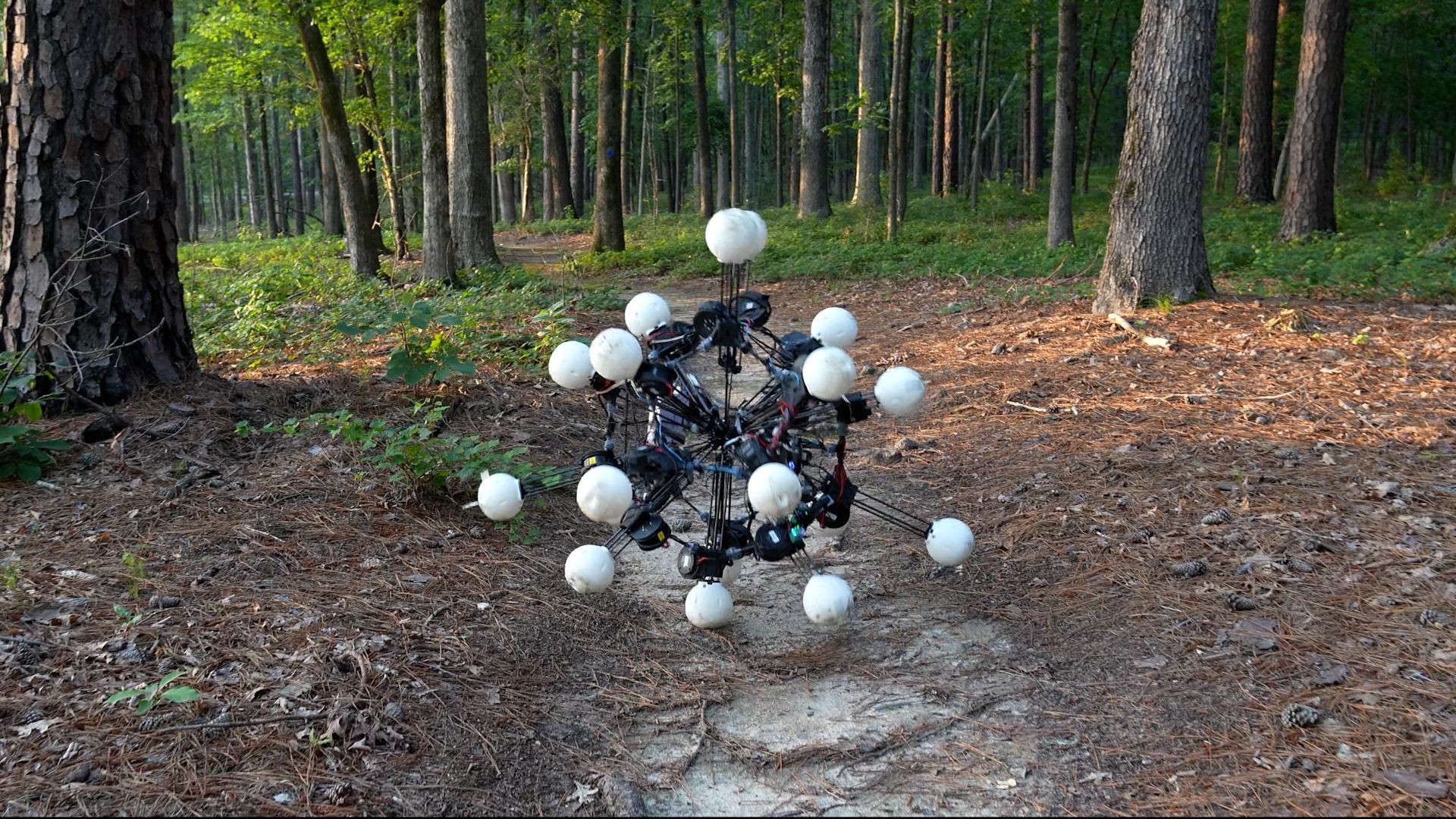
A weird machine with twenty legs.
It might actually change the rules for what a robot should look like.
For years we’ve watched roboticists copy nature. We see humanoids walking like people, machines running on four legs like dogs, maybe some insect-inspired crawlers or mechanical horses.
But new research suggests that ideal body shape isn’t a copy of us at all.
It’s closer to a sea urchin 🦔
Duke University researchers built a robot called Argus — named for the all-seeing mythological giant because, well, it sees in every direction. The design is radical in its simplicity and complexity. It has no front. No back. No top, really, since the central body is just a hub.
Instead, twenty telescoping legs radiate out from the center.
Each leg costs $300. Each tip has a depth camera.
This allows Argus to move in any direction. It can stabilize itself after being shoved. It handles rough ground, carries a 4.5kg payload, and yes, it climbs walls.
Chasing Symmetry
How do you find this design?
You don’t ask “what animal is strongest?”
The team ran more than 1,50 simulations of different shapes. They looked for something mathematical called dynamic isotropy. It sounds boring but it isn’t. The score runs from 0 to 1.
1 means the robot can accelerate its mass identically in every direction.
“When a robot can accelerate equally well… Forward and backward become the same.”
That’s Boyuan Chen from the Duke General Robotics Lab explaining the shift in perspective. When direction doesn’t matter for control, the problem of navigation changes entirely.
Most robots score below 0.6.
Even the fancy four-legged dogs or humanoid bots are directional. They are better at going forward than sideways or backward.
Argus scored a 0.91.
Nearly the theoretical max.
They achieved this by arranging the body around a regular dodecahedron. That’s the 12-faced geometric shape made of pentagons. It creates a nearly uniform field of vision. The robot doesn’t need to orient itself. It just goes.
“The whole problem of robot control changes character.”
Real World Chaos
Does math work outside the computer?
To prove it the team dragged Argus across the Duke campus.
Concrete. Grass. Dense bushes. Sand. Wet spots. Tree bark.
The robot climbed over obstacles as high as 5 inches (13 cm). It rolled while pushing a cube the size of a small fridge.
And here’s the kicker.
Someone broke three of the legs.
It kept moving.
Is Argus the future of consumer robotics?
Probably not yet. It’s a proof of concept. The real value here isn’t the machine itself but the method used to build it. It proves that we don’t need to imitate biology to get agility.
We can build from geometry instead.
So maybe stop looking at horses for inspiration.
Look at the urchin. 🦔
Look at the sphere.
Look at what happens when you remove the idea of “forward.”