A Cold Start
New research says Charon, Pluto’s biggest moon, is still losing spin energy. This is true despite the two being locked together for ages. It gives scientists a rare look inside distant icy worlds.
Objects in the Solar System usually go through despinning. Tidal forces slow them down. Shape changes. Temperature shifts.
For Pluto’s moon, this was always theory. Now it feels real.
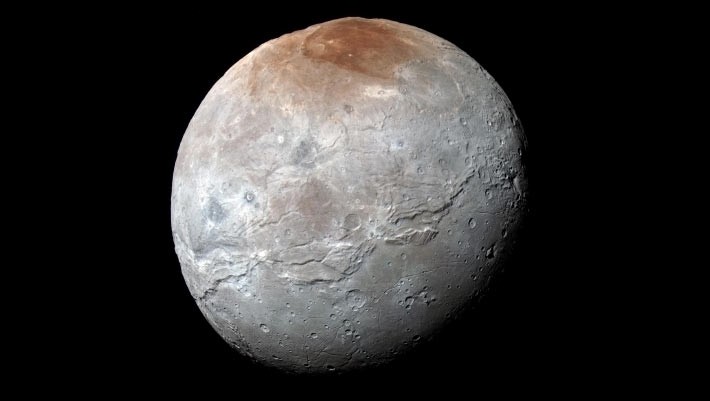
“Charon exhibits a topographic dichotomry of rugged northern highlands and smoother southern plains” — Dr. Hanzhang Chen.
The moon is a great candidate. Its surface is old, roughly 4 billion years. Unlike other icy moons, it hasn’t been resurfaced much. It keeps its history.
Dr. Chen from UCLA and ETH Zurich notes previous ideas about global extension. Cryovolcanism, they said. But the new study digs into Oz Terra in the northern hemisphere. They looked at mountain ranges. Over 200 km long. Asymmetric slopes.
These features show compression. Not extension.
Modeling puts the ice shell thickness at 30-36 back then. The equatorial crust shrunk about 1 percent. Existing faults took the hit. That created the ridges we see today.
The numbers add up. Early rotation was around 14.3 hours. Fast. Compare that to the current tidally locked slog of 153 hours. It slowed down. Gradually. A despinning process confirmed by the ground beneath.
Implications
This implies a cold beginning. Charon didn’t form hot and melt. It formed with a thick, rigid ice shell right out of the gate.
The authors argue this surface records planetary history. Before the global extension stuff happened. Despinning and contraction coevolved. This points to a “cold start” model. Useful for understanding how other outer solar system icy moons evolved thermally.
Who knew the moon was hiding that story in its faults?
The paper dropped on Nature Communications July 14. Chen et al., 2026
The coevolution of despinping and global contraction favors a cold start offering insights into the early theermal evolution of icy satelites