Recent disclosures by the U.S. Department of Defense have reignited public fascination with the Apollo 12 mission, not for its historic achievement as the second lunar landing, but for a series of declassified images and transcripts that appear to show unidentified lights on the Moon. While these materials have been publicly available for decades, their inclusion in a batch of roughly 150 newly released files related to Unidentified Anomalous Phenomena (UAP) has framed them as potential evidence of extraterrestrial activity. However, a closer look at the historical context and scientific explanations suggests a far more mundane reality.
The Original Observation
In November 1969, astronauts Charles “Pete” Conrad Jr. and Alan L. Bean descended to the lunar surface in the Intrepid lunar module. While preparing for their excursion, Bean used the lander’s alignment optical telescope—a periscope-like device designed to help orient the spacecraft—to look outside. He reported seeing “particles of light” and “flashes of light” moving rapidly across the field of view.
Initially, Bean suspected the lights might be debris leaking from the lander’s water boiler. However, he later noted that the objects seemed to be originating from the lunar surface itself, describing them as escaping the Moon and speeding toward the stars. These comments were recorded in mission control transcripts, which have been part of the public record since the mission concluded.
The Declassified Images
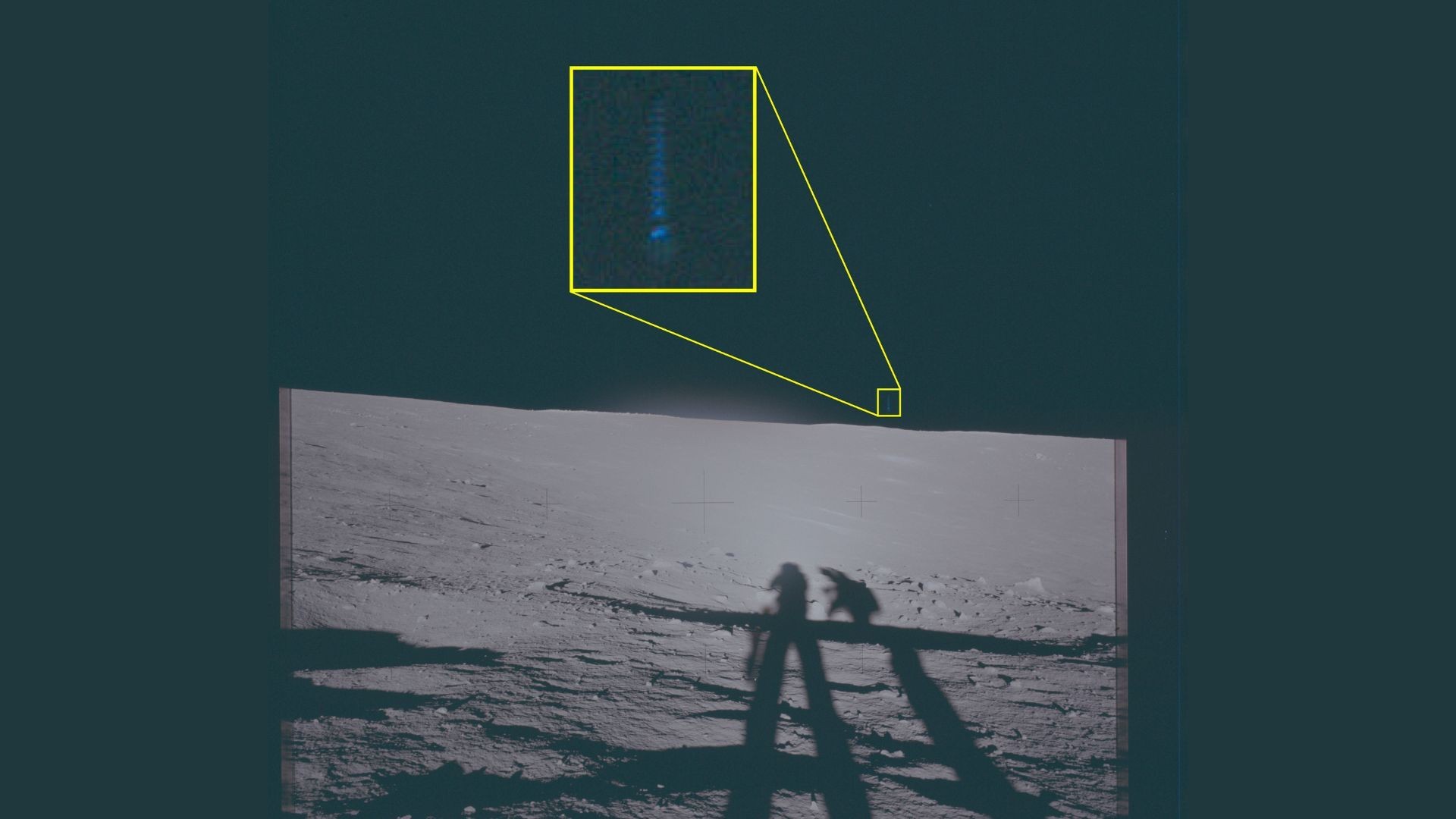
The newly emphasized photographs show bluish lights appearing in the sky above the lunar horizon, sometimes individually and sometimes in clusters. In one notable image, lights are highlighted in five distinct regions of the sky. These images are not new discoveries; they were taken during the Apollo 12 mission and have been accessible to the public since the 1960s.
What is new is the way they are being presented. The Department of Defense has released these files alongside other alleged UFO sightings, with NASA having previously highlighted and zoomed in on the light sources. This formatting hints that the agency investigated the phenomenon at the time, though no definitive conclusions were ever drawn. The visual artifacts remain blurry and ambiguous, offering scant scientific data beyond their existence as photographic anomalies.
Scientific Explanations Over Extraterrestrial Hypotheses
During the mission, mission control proposed that the flashes could be electromagnetic interference, either from human-made technology or cosmic radiation such as solar flares. The astronauts acknowledged this possibility, and the investigation was effectively closed without further action.
Today, experts maintain that UAP sightings are rarely evidence of alien life. NASA’s decades-long search for extraterrestrial intelligence using advanced telescopes has yielded no contact. Instead, a 2022 Department of Defense investigation identified common causes for UAP reports, including:
- Airborne debris and optical illusions
- Photo defects, such as lens glare or sensor noise
- Atmospheric phenomena, like weather balloons or birds (in Earth-based sightings)
In the vacuum of space, static electricity, dust particles, and sensor artifacts can create similar visual effects. The “dancing lights” seen in the Apollo 12 photos are likely the result of these mundane physical processes rather than intelligent craft.
Why This Matters
The re-emergence of these Apollo 12 records is less about uncovering alien secrets and more about government transparency. By declassifying these decades-old files, the Department of Defense is addressing public demand for openness regarding UAP investigations. While the images do not provide proof of extraterrestrial life, their release signals a shift toward acknowledging the phenomenon as a subject of legitimate, albeit unresolved, inquiry.
The declassification of these photos represents a small step toward transparency, not a giant leap for UAP studies. The lights remain unexplained in detail, but the likely culprits are physics and optics, not aliens.
In conclusion, while the Apollo 12 “UFO” images capture the imagination, they ultimately reinforce the importance of scientific scrutiny over speculative mystery. The records serve as a reminder that even in the most historic moments of human exploration, the unknown is often explained by the ordinary.