Jacopo Peri didn’t just write music. He changed how it sounded forever. Born in 1561, either in Rome or the nearby city of Florence, this Italian composer became the architect of a new kind of vocal drama. He died in Florence in 1633, leaving behind a legacy that shifted the entire trajectory of Western music.
Before he was a pioneer, Peri was just a working musician. He got his start under the patronage of Cristofano Malvezzi in Florence. By 1583, he had already published instrumental pieces and madrigals. He worked as an organist and singer, landing a steady job with the powerful Medici court in 1588. Later, his reputation grew enough to connect him with the court in Mantua around 1600. Contemporaries noted he wasn’t just a composer. He was a skilled singer and a proficient player of the chitarrone, a large bass lute.
How Jacopo Peri Revolutionized Early Baroque Opera
The big shift happened when Peri started collaborating with poet Ottavio Rinuccini and fellow musician Jacopo Corsi. This group was obsessed with one idea: ancient Greek drama. They believed the Greeks spoke their plays through song. They wanted to recreate that simplicity. It was a direct rejection of the complex polyphony that dominated the Renaissance.
Peri and his circle sought to mimic the emotional power of Greek theater. They wanted music that served the text, not the other way around. This experiment led to La Dafne in 1598. Most scholars agree this was the very first opera. The music for La Dafne is largely lost, which is a tragedy. But Peri didn’t stop there.
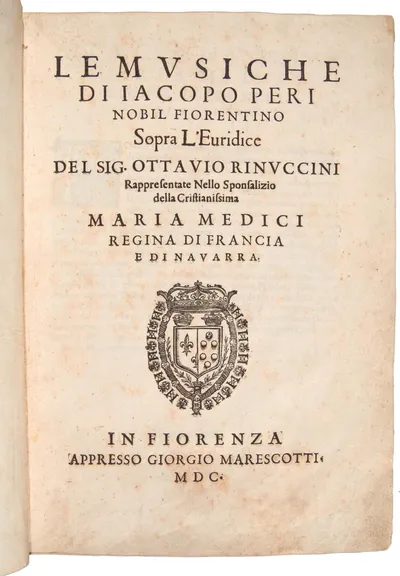
In 1600, he and Rinuccini delivered L’Euridice. This is the first opera where complete music still exists. It’s a crucial document for understanding how dramatic vocal style evolved. The premiere was a major event. In fact, Peri’s rival at court, Giulio Caccini, also contributed music to that same performance. Caccini’s style was different—more ornate, more melodic. The two competed for the crown of this new art form.
Why Jacopo Peri’s Work Still Matters Today
Peri’s approach was stark. It was monodic, meaning a single vocal line with simple accompaniment. This stood in sharp contrast to the dense, interweaving voices of earlier composers. The Florentine Camerata, the group of intellectuals including Giovanni Bardi and Vincenzo Galilei, pushed for this change. They argued that music should clarify the emotions of the words.
This wasn’t just a theoretical exercise. It was a practical revolution. Composers had to figure out how to make recitative work. How do you sing speech-like lines without losing musicality? Peri figured out much of that groundwork. His collaboration with Rinuccini provided the texts. His setting provided the musical framework.
The result was a style that could carry a story. It wasn’t just a collection of songs. It was drama. This innovation rippled out from Florence. Other composers adopted and refined the style. But the core idea remained the same. Music must serve the drama.
Peri’s L’Euridice