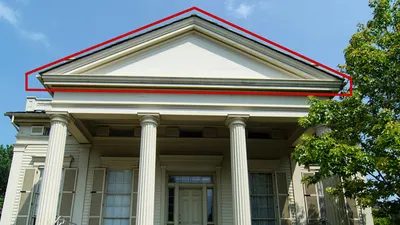
It’s a triangle. That is the basic truth of it.
But in architecture, a triangle is never just a shape. It’s a statement. A pediment is a triangular gable that sits at the end of a roof slope, usually over a portico or doorway. It is the capstone of the building’s identity. To the Greeks it was not an ornament. It was the crown.
A triangular wall space within this frame—the tympanum —rested on a horizontal band of moldings supported on columns. This space was prime real estate for sculpture. A view of the Parthenon in Athens. That between 447 and 432 BC. Built in the 1st century BC, the tympanum is filled with figures telling myths in stone. The whole was crowned by a sloping cornice that followed the slope of the roof. It was rigid. It was perfect.
The Romans looked at this Greek perfection and asked, “What if we just use this for windows?”
They have stripped it of its structural necessity. The Roman gable became purely decorative. You can see it above niches, doors and especially windows. They also started playing with shapes. Instead of just a triangle, they were mixed with segmentally curved, semi-circular pediments. This alternating motif has not disappeared. During the High Renaissance, it returned with a vengeance.
Take the Palazzo Farnese in Rome. Construction began in 1517 based on a plan by Antonio da Sangallo the Younger. Check out the Piano Nobile – above the ground floor. The windows are crowned with pediments that illustrate this revived classical language. It was no longer just about sheltering the window. It was all about rhythm. About balance.
Then came the Baroque period, and nothing was sacred.
Late Roman precedents had already shown that a raking cornice could be cut before it reached its peak. Baroque designers took this crack and blew it open. They created broken, decorative and even inverted curved pediments. The form became fluid. There was movement.
Gian Lorenzo Bernini understood this better than anyone else. His work on the Church of San Andrea al Quirinale in Rome (1658–70) is a masterpiece in this regard. The pediment just doesn’t stand there. It dances. It breaks. It bends.
The designers even flipped the script. Sometimes the highest points of a broken gable point outward, away from the center of the composition. It created tension. It pulled the eye out instead of letting it rest in the middle.
And in Spain, the churrigueresque style—late Renaissance baroque to the extreme—fragmented these forms even further. The Small sections became decorative motifs scattered across the facades. The structure dissolved into the decoration.
We still see these forms today. We simply don’t notice them anymore. But this triangle? It’s been holding up stories for two millennia. What happens when you finally let it fall apart?