Three isolated bones, dug up nearly thirty years ago in northern Kyushu, are finally telling us what they were hiding. For decades, they just sat there. Labels said Andrias. Standard practice. But a fresh look by Kyoto University researchers has blown the lid off that assumption.
These aren’t just old giant salamander bones. They belong to a distinct, lost species.
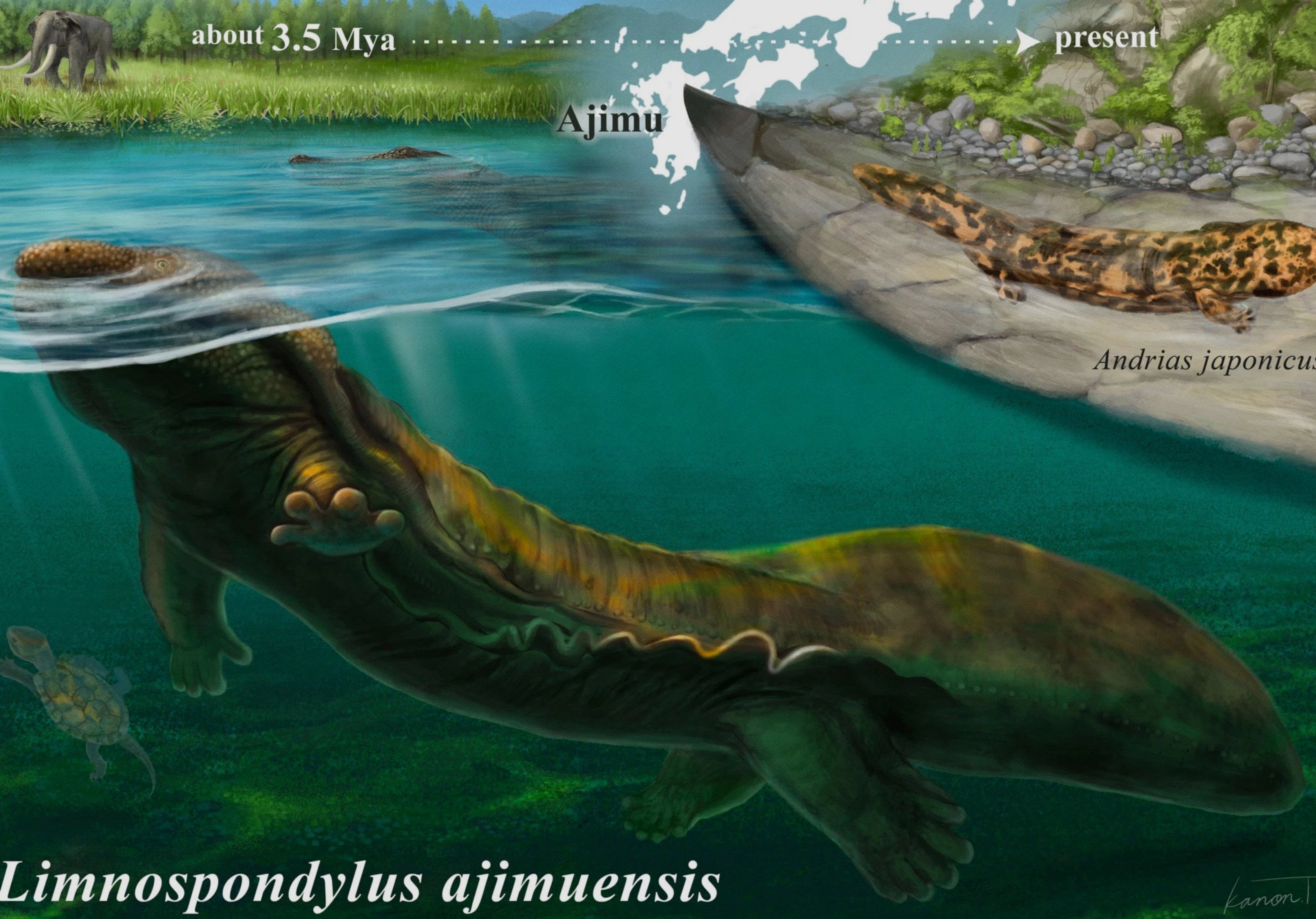
Named Limnospondylus ajimuensis, this amphibian prowled the lakes of what is now Oita Prefecture roughly 3.5 million years ago. It grew to about 1.1 meters (3.7 feet). That makes it a serious contender for the largest amphibians on Earth, even today. It took nearly eighteen years for it to hit that size. Slow growth? Or just a different life history strategy? We don’t know yet. But the implication is clear: ancient Japan hosted giants we never imagined.
The Ajimu Discovery and Ancient Environment
The fossils came from the Ajimu region in the Tsubusugawa Formation. Digged out between 1995 and 2007, these three vertebrae—front trunk, mid-trunk, and sacro-caudal—didn’t come from one animal. They came from different individuals. Different sizes. Different spots.
This matters because the environment back then was radically different. Northern Kyushu was a wet, warm jungle of freshwater lakes and marshes. Elephants hung out there. Crocodiles, too. Creatures that don’t exist in Japan anymore. It was a prehistoric ecosystem, lush and teeming.
“Ajimu contains the only site in the worldwhere fossils of the giant salamander family andextant genera have both beenfound,” says lead author Masahiro Noda.
That uniqueness is why this find hits hard. It’s not just another bone. It’s a window.
Why Scientists Created a New Genus
Back in 2001, scientists slapped these bones into the Andrias genus. Standard ID for giant salamanders. But they lacked enough material. Too many questions. Now, the team at Kyoto University had the full picture. They compared the fossils against a massive collection of both modern and extinct specimens.
The mid-trunk vertebra was the key. It showed anatomical features that didn’t match any known member of Cryptobranchidae, the family giant salamanders belong to. The differences weren’t minor. They were fundamental.
So, they built a new house. A new genus. Limnospondylus. Greek for “lake vertebra”. Ajimuensis honors the discovery site. Simple. Effective. It acknowledges that this creature lived differently. It preferred still waters. Lakes. Ponds. Not the fast-flowing rivers that current giant salamanders rely on.
Filling the Evolutionary Gap
Giant salamanders have been around for roughly 60 million years. They used to roam the Northern Hemisphere. But their Asian fossil record has a massive blind spot. A gap of over 20 million years sits between ancient species and the few relatives we see today.
This new genus helps stitch that timeline together. Before now, only five genera in the family were described. Five. Now there’s six. This suggests ancient Asian salamanders were far more diverse than we thought. They occupied a wider range of habitats. They weren’t just river-dwellers.
It forces a rethink of museum drawers. Lots of fragmentary remains labeled Andrias might actually be Limnospondylus or something else entirely. Researchers have been grouping them by default. Lack of evidence led to over-classification. This new discovery breaks that pattern.
Survival, Extinction, and Conservation
Why did it go extinct? Probably climate. The end of the Pliocene saw global cooling. Lakes dried up. Wetlands shrank. The habitat disappeared.
But one branch survived. Andrias japonicus, the Japanese giant salamander, is still here. In rivers in the Ajimu area and beyond. It’s a living link to that prehistoric past. A rare survivor.
Yet it’s struggling today. Hybridization with foreign species. Habitat destruction. Noda points this out clearly.
“Recently, Japan’s native giant salamandershave faced challenges such ashybridization with foreign speciesand habitat destruction,” says Noda.
This research isn’t just about the past. It’s a warning. A reminder of what we’ve already lost. And what we might lose next. The connection between the ancient lakes of Ajimu and the modern rivers is thin. Fragile.
We know the bones were real. We know what they looked like. We know where they lived. But the bigger picture—how exactly this lineage survived when others vanished, how it might adapt now—is still unfolding. The story isn’t finished.