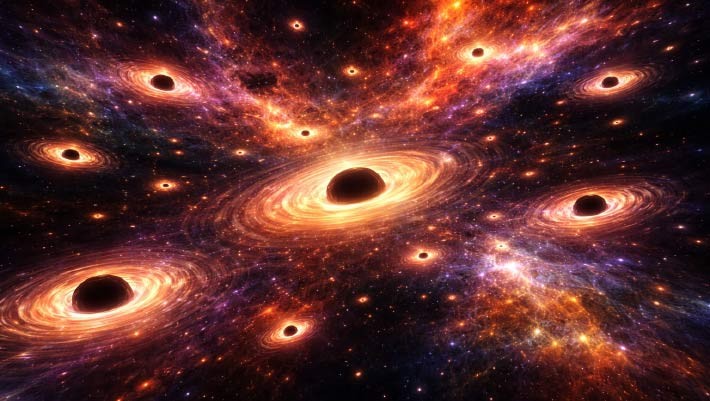
New research suggests that our Universe may not have begun with a singular, explosive “Big Bang,” but rather emerged from a “cosmic bounce.” If this theory holds true, some black holes currently drifting through space might actually be “fossils”—ancient objects that formed before our current expansion began and survived the transition.
Beyond the Singularity
For decades, the standard cosmological model has posited that the Universe began approximately 13.8 billion years ago from a singularity—a point of infinite density where the known laws of physics cease to function. However, many physicists view this “singularity” not as a physical reality, but as a mathematical signal that our current theories are incomplete.
Professor Enrique Gaztañaga, from the University of Portsmouth and the Institute of Space Sciences in Barcelona, proposes an alternative: Bouncing Cosmology.
In this model, the Universe does not start from nothing. Instead, it undergoes a cycle of contraction followed by a rebound. Rather than collapsing into an infinite point, the Universe reaches a state of extreme, yet finite, density. At this stage, quantum effects create a powerful outward pressure—similar to the forces that stabilize neutron stars—triggering a “bounce” into the expansion we observe today.
The Survival of ‘Cosmic Fossils’
The most provocative aspect of this research is the survival of ancient structures. According to calculations published in Physical Review D, compact objects larger than approximately 90 meters could potentially survive the transition from a contracting Universe to an expanding one.
These “relic” objects could include:
– Ancient Black Holes: Massive remnants from the previous cosmic era.
– Gravitational Waves: Ripples in spacetime from the pre-bounce phase.
– Density Fluctuations: Patterns in matter that shaped the early Universe.
Solving Cosmological Mysteries
If these relic black holes exist, they could provide much-needed answers to several of the most enduring puzzles in physics:
1. The Dark Matter Mystery
Dark matter is an invisible substance that outweighs ordinary matter five to one, yet its composition remains unknown. If a vast number of these relic black holes were formed during the bounce, they could account for a significant portion—or even the entirety—of the dark matter shaping our galaxies today.
2. The ‘Little Red Dots’ Paradox
Recent observations from the James Webb Space Telescope (JWST) have revealed unexpectedly massive objects in the very early Universe, often referred to as “little red dots.” Standard models struggle to explain how such massive black holes could grow so quickly after the Big Bang. However, if these black holes were already present as “fossils” immediately following the bounce, they wouldn’t need to “start from scratch,” explaining their sudden appearance in the cosmic timeline.
3. Inflation and Dark Energy
The bouncing model also offers a natural explanation for cosmic inflation (the rapid expansion of the early Universe) and may even shed light on dark energy, the mysterious force driving the current acceleration of the Universe’s expansion.
Looking Ahead
While the theory is compelling, it remains unproven. Scientists are now looking toward future observations to find “smoking gun” evidence, such as subtle patterns in the Cosmic Microwave Background (CMB) or specific gravitational wave signatures that could only have originated from a pre-bounce epoch.
“If the Universe did experience a bounce, the dark structures shaping galaxies today could be remnants from a cosmic epoch that preceded the Big Bang.”
Conclusion: By replacing the concept of a singular beginning with a cosmic cycle, this theory offers a potential bridge between quantum physics and cosmology, suggesting that the very foundations of our Universe might be much older than the Big Bang itself.