Bright blue. Dark green. They don’t exactly mix in nature. But from space, southeast Utah looks like someone spilled paint on a map.
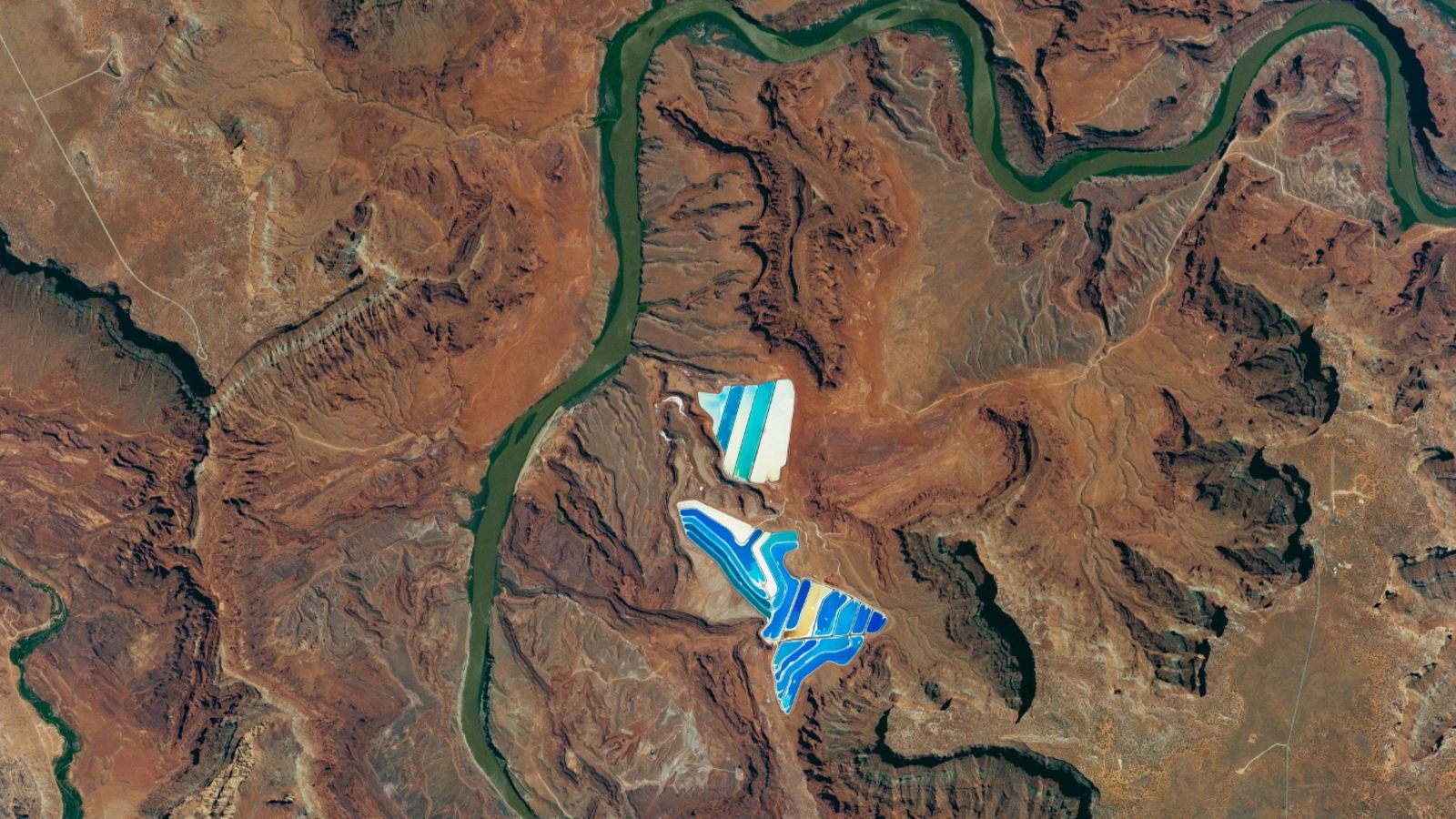
The photo shows bright-blue “potash ponds” sitting right next to the winding, dark-green curves of the Colorado River. It’s jarring. And deliberate.
The Alchemy of Color
These aren’t swimming holes. They’re solar evaporation ponds. Roughly 8 miles southwest of Moab. Deep in the Colorado Plateau, that elevated rock span covering parts of Utah, Arizona, New Mexico, and Colorado.
There are 23 of them. Two big structures holding 400 acres of industrial processing. They make potassium chloride. Or potash. The stuff gets mined right below the ponds in this view, pumped out with boiling water to create mineral-rich brine. That liquid then travels to these shallow pools.
Here’s the trick. Workers add dark-blue dye. It makes the water absorb more sun. Speeds up evaporation. But the dye evaporates too. As the water shrinks, the blue fades. White follows. Then tan. What’s left is dried potash crystal. Tiny, brown, useful.
“The distinct colors signify that they are at different stages.”
Why bother? Potash feeds crops. It’s the main ingredient in fertilizer. But it also goes into medicines, cement, fire extingushers, even beer. Who knew beer needed salt mines?
The name “potash” itself is a throwback. Preindustrial farmers mixed wood ash with water, boiled it in pots, and evaporated it. “Pot ash.” When they discovered potassium was the magic ingredient inside, they kept the name. We’re still stuck with it.
The Cost of the Shine
Mining always takes a toll. Habitat destruction. Noise. Potash is messy though. It leaves behind waste. Sodium chloride. Clay. High volumes of it.
This salty sludge gets piled into mounds or dumped in tailings pools. Sometimes, rain washes it away. A 2017 paper noted this runoff enters nearby waterways. It can wreck biological communities. Spark harmful algal blooms. Messy stuff.
Does it affect the Colorado River? We don’t really know. Yet.
The Green Stain
The river nearby doesn’t care about our ignorance. It’s the sixth longest river in the U.S. Stretching 1,450 miles from the Colorado Rockies down to Mexico. It carved the Grand Canyon. That’s a good trick.
But here it looks green. Why? Sediment. Lots of it, suspended in the flow. Same reason its tributary, the Green River, wears the same hue. It’s dirty water. Essential, dirty water.
The blue ponds sit quietly. The river flows on. You can’t tell which will win, but the landscape has already been altered.
See more Earth from space. 👁️