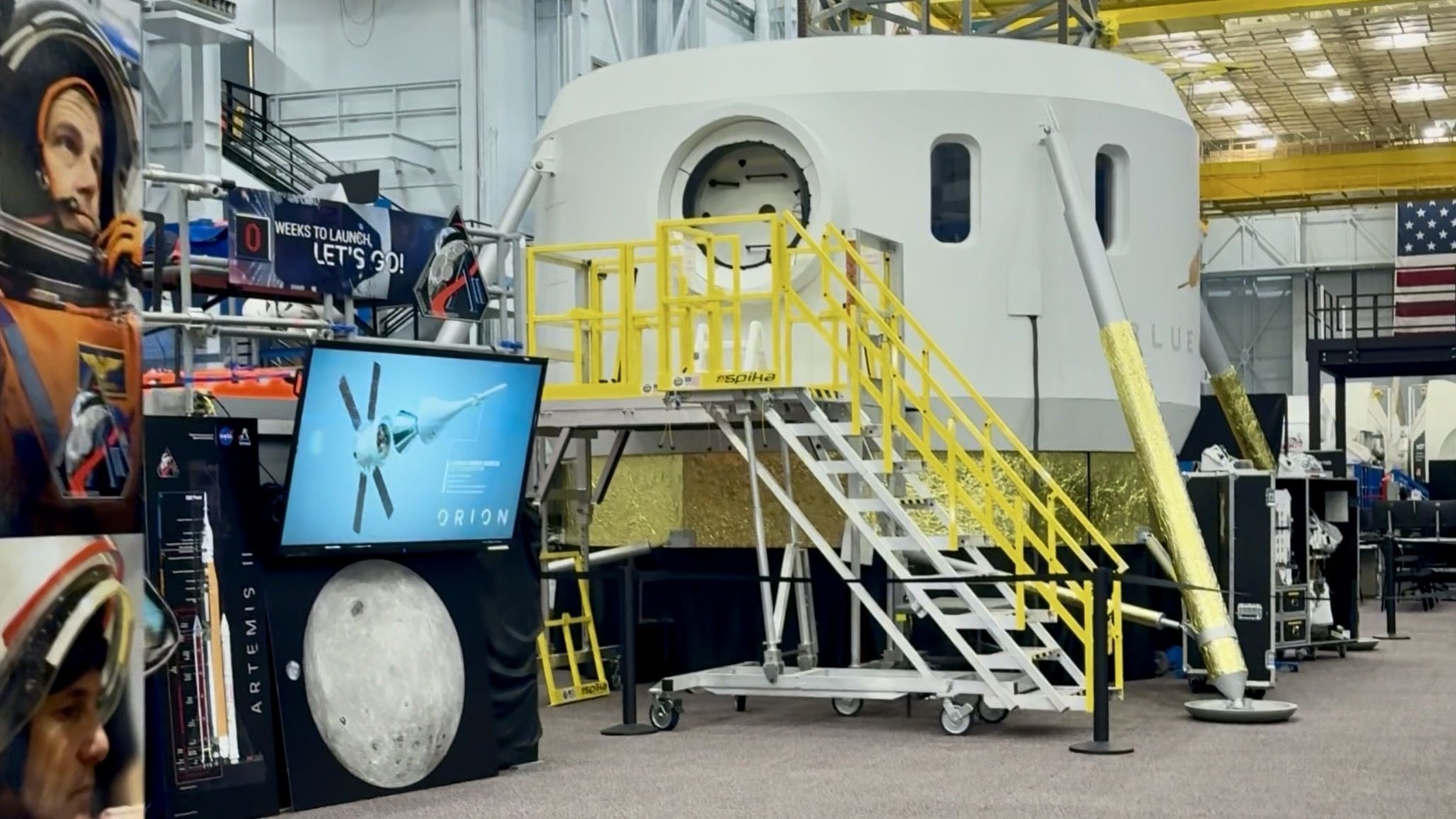
Blue Origin’s Blue Moon Mark 2 (MK2) lunar lander mockup has officially joined the training facilities at NASA’s Johnson Space Center in Houston. The full-scale model is now positioned inside the Space Vehicle Mockup Facility (SVMF), standing adjacent to the Orion space capsule simulator. This strategic placement allows astronauts to practice seamless transitions between the spacecraft that will carry them to lunar orbit and the lander that will take them to the surface.
A New Neighbor for Orion
For years, the Orion simulator—where Artemis 2 astronauts spent over a year preparing for their historic lunar flyby—stood somewhat isolated within the SVMF, separate from the International Space Station training modules. The arrival of the Blue Moon mockup changes this dynamic, creating a more integrated training environment.
The mockup replicates the crew cabin and exterior design of the Blue Moon MK2, the specific variant intended to land Artemis astronauts on the moon. While the model is not the final flight hardware, it serves as a critical test article. NASA plans to use it to gather feedback from astronauts, which will inform Blue Origin’s ongoing development of the actual vehicle.
Why This Matters: The Race for Artemis 3
The installation of the Blue Moon mockup is more than a logistical update; it signals progress in one of the most complex aspects of NASA’s Artemis program: Human Landing System (HLS) development.
NASA has awarded HLS contracts to two companies:
* Blue Origin (Blue Moon)
* SpaceX (Starship)
Both vehicles have faced significant development delays. However, Blue Moon is the first of the two to integrate a cabin model for training within a NASA facility. In contrast, while astronauts have tested early Starship cabin designs and its unique elevator system at SpaceX’s own facilities, those tests have remained outside the official NASA training ecosystem.
Context: The Artemis 3 mission, currently scheduled for late 2027, depends entirely on at least one lander being flight-ready. NASA Administrator Jared Isaacman has stated that the agency is willing to fly with either vehicle, or both, depending on which reaches readiness first.
Training for a New Era of Lunar Exploration
The integration of the Blue Moon mockup allows astronauts to rehearse critical procedures that differ significantly from the Apollo era. During Artemis 3, four astronauts will travel to low Earth orbit aboard Orion, where they will rendezvous with the lunar lander. They will practice docking, verify life support systems, and prepare for the descent.
A major component of this training involves the new Axiom Space spacesuits. Although these suits have also faced delays, astronauts have already had opportunities to test prototypes alongside Starship’s elevator mechanism—a 170-foot (52-meter) descent from the cabin to the base. By comparison, the Blue Moon MK2 is approximately 52 feet (16 meters) tall, with the crew cabin located near the base, offering a different operational profile.
The Engineering Challenge: Single-Stage Return
The presence of these mockups highlights a fundamental shift in lunar exploration strategy. Unlike the Apollo missions, which used a two-stage lander that abandoned the descent stage on the moon to save weight for the return trip, Artemis landers must be single-stage vehicles.
This requirement is driven by NASA’s goal of sustainable, long-term habitation. Leaving half a spacecraft on the lunar surface for every mission is environmentally and logistically untenable for a permanent base. To achieve a single-stage landing and launch back to orbit, both Starship and Blue Moon must master on-orbit refueling.
This capability requires:
1. Transfer of cryogenic propellants in space.
2. Long-term storage of these fuels in orbit.
Neither of these technologies has yet been demonstrated in space. Consequently, before astronauts can fly, NASA requires successful uncrewed test flights to the lunar surface for each lander. Only after these milestones are met will the vehicles be qualified for crewed missions.
Conclusion
The assembly of Blue Origin’s Blue Moon mockup at Johnson Space Center represents a tangible step toward the Artemis 3 mission. While significant engineering hurdles remain—particularly regarding on-orbit refueling and final hardware certification—this integration allows astronauts to begin the crucial work of preparing for humanity’s return to the lunar surface.