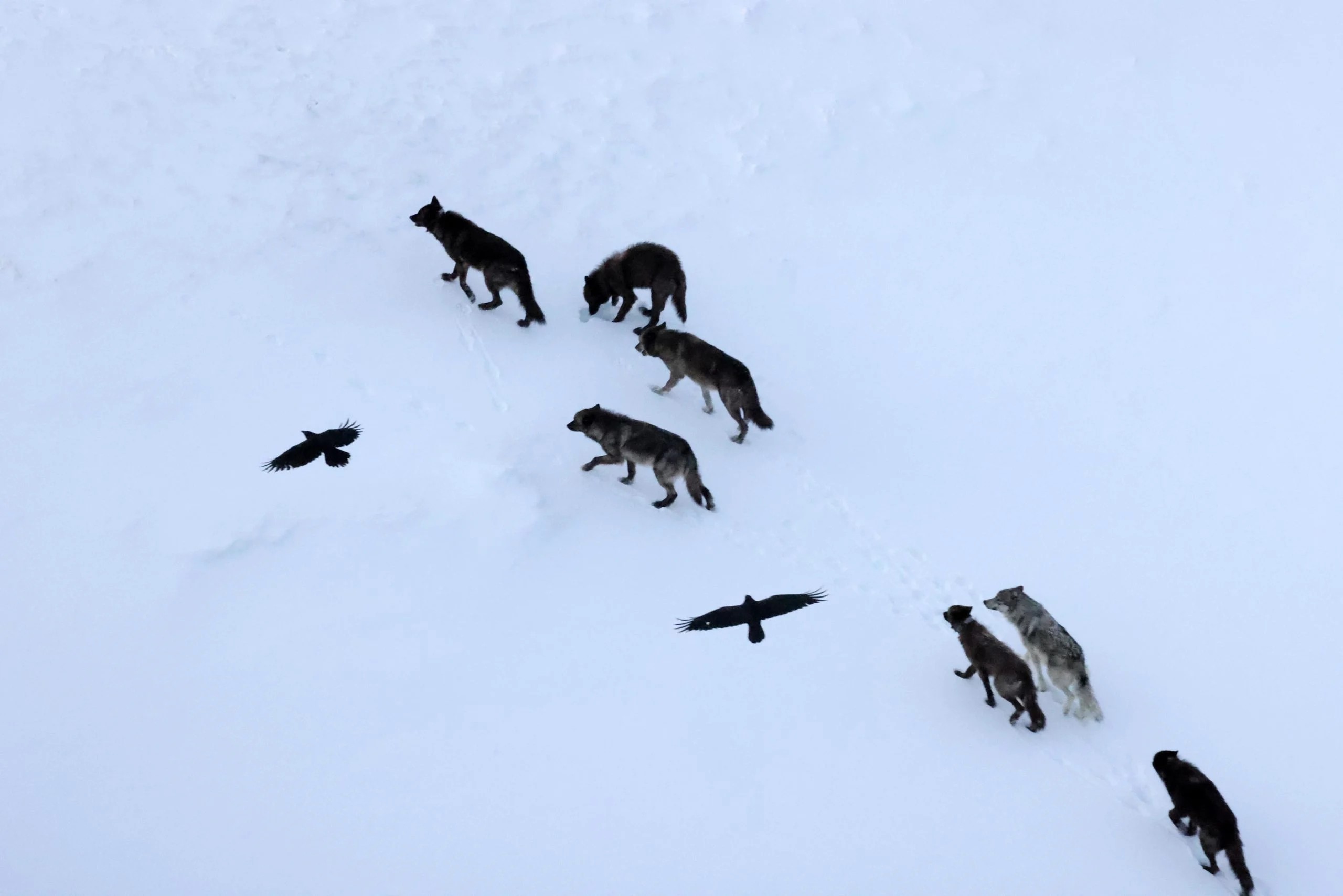
For decades, wildlife observers in Yellowstone National Park witnessed a striking phenomenon: as soon as wolves brought down prey, ravens appeared on the scene. The birds swooped in to claim scraps of meat, often arriving before the predators had finished feeding. This near-instantaneous arrival led to a widespread assumption: that ravens simply shadowed wolf packs across the landscape, trailing them like loyal scavengers.
However, a groundbreaking study published in Science overturns this long-held belief. Researchers have discovered that ravens do not merely follow wolves; they predict where wolves will kill. By leveraging sophisticated spatial memory and navigation skills, these birds independently travel to high-probability hunting grounds, demonstrating a level of cognitive flexibility that challenges our understanding of scavenger behavior.
The Myth of the Shadow Scavenger
The conventional wisdom held that ravens operated on a simple rule: stay close to wolves to find food. Dr. Dan Stahler, a Yellowstone biologist who has studied wolves since their reintroduction in the mid-1990s, notes that this assumption was intuitive. “You see them flying directly above traveling packs or hopping close behind wolves as they take down prey,” Stahler explains. “We all assumed that the birds had a very simple rule; just stick close to the wolves.”
Yet, this explanation lacked empirical testing. As Stahler points out, “We didn’t know what ravens were capable of because nobody had ever put them at the center; nobody had taken the scavenger’s point of view.”
To resolve this mystery, an international team of researchers led by the Research Institute of Wildlife Ecology at the University of Veterinary Medicine Vienna and the Max Planck Institute for Animal Behavior launched a comprehensive tracking study. The project involved fitting 69 ravens with tiny GPS devices and analyzing data from 20 collared wolves over a period of more than two years.
Capturing the Cunning
Tracking ravens proved to be a significant logistical challenge. Unlike wolves, which are often monitored via collars, ravens are highly observant and wary of unfamiliar objects in their environment. “Ravens are so observant of the landscape that they don’t step into traps easily,” says Dr. Matthias Loretto, the study’s lead author.
To successfully capture the birds for tagging, researchers had to employ creative camouflage strategies. Near campsites, traps were disguised using trash and fast-food packaging to blend into the human-impacted environment. “Otherwise, the ravens would suspect that something was off and wouldn’t come near it,” Loretto explains. This meticulous effort allowed scientists to collect high-resolution movement data, recording raven locations every 30 minutes and wolf locations every hour during the winter months, when interactions between the two species are most frequent.
Memory Over Proximity
The data revealed a surprising disconnect between the movements of wolves and ravens. Over the course of the study, scientists found only one clear case in which a raven followed a wolf for more than one kilometer or for longer than one hour.
“At first, we were puzzled,” Loretto admits. “Once we realized that ravens are not following wolves over long distances, we couldn’t explain why the birds still arrive so quickly at wolf kills.”
The answer lay in the ravens’ exceptional memory. Instead of trailing individual predators, ravens learned to identify landscape patterns. Wolf kills in Yellowstone are not random; they cluster in specific areas, particularly flat valley bottoms where wolves hunt more successfully. Ravens appeared to memorize these productive zones.
The birds demonstrated the ability to fly vast distances—up to 155 kilometers in a single day—along remarkably direct routes toward areas where carcasses were statistically likely to appear. “Ravens can cover large distances by flying, and they seem to have a good memory, so they don’t need to constantly follow wolves in order to profit from the predators,” Loretto says.
A New Understanding of Animal Intelligence
This finding highlights a sophisticated cognitive strategy. While a single wolf kill is unpredictable, the probability of a kill occurring in certain areas is stable over time. Ravens appear to have learned these long-term feeding patterns, allowing them to anticipate food sources rather than just reacting to them.
Locally, ravens may still use short-range cues—such as wolf howls or visual signs of a struggle—to pinpoint the exact location of a kill once they are in the vicinity. However, the broader navigation strategy is driven by memory.
“What our study clearly shows is that ravens are flexible in where they decide to feed. They don’t stay tied to a particular wolf pack. With their sharp senses and memory of past feeding locations, they can choose among many foraging opportunities far and wide.”
— Prof. John M. Marzluff, University of Washington
This flexibility suggests that ravens are not passive followers but active strategists. They integrate information about landscape topography, prey distribution, and predator behavior to optimize their foraging efficiency.
Why This Matters
The implications of this study extend beyond Yellowstone. It forces a reevaluation of how we perceive scavengers and their role in ecosystems. Traditionally viewed as opportunistic followers, ravens are now recognized as intelligent navigators capable of complex spatial reasoning.
This research raises important questions about animal cognition:
* How many other species rely on predictive memory rather than immediate sensory cues?
* Have we underestimated the intelligence of animals that do not exhibit “social” behaviors typical of mammals?
* How does this flexibility impact ecosystem dynamics, such as nutrient cycling and seed dispersal?
As Prof. Marzluff concludes, “This changes how we think about how scavengers find food—and suggests we may have underestimated some species for a long time.”
Conclusion
The relationship between ravens and wolves in Yellowstone is not one of master and servant, but of independent actors navigating a shared landscape. By relying on memory rather than proximity, ravens demonstrate a remarkable ability to predict the future based on past patterns. This study not only illuminates the intelligence of corvids but also reminds us that nature’s strategies are often far more complex than they initially appear.