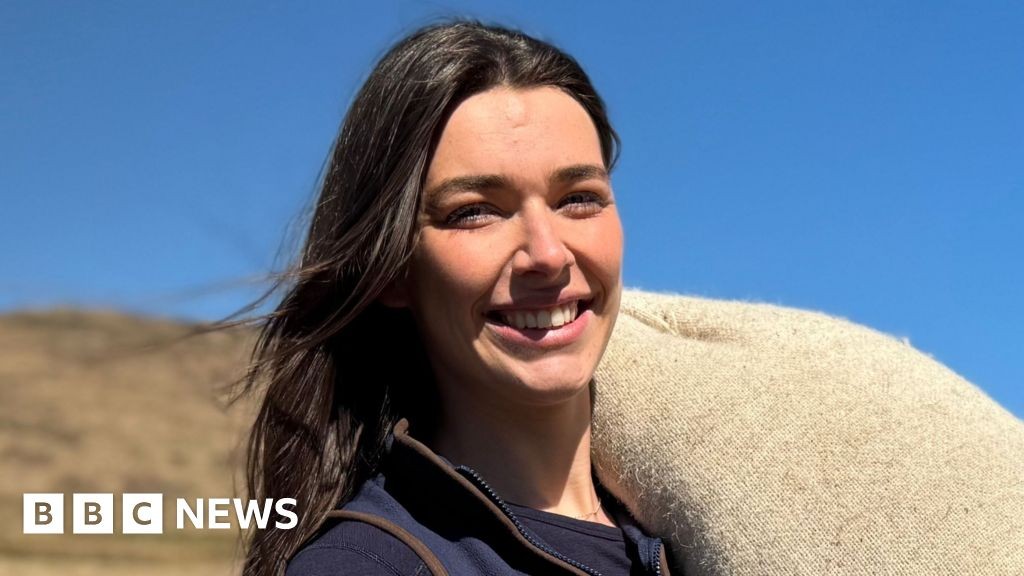
It is happening on Slievenanee. A wintry Tuesday in February.
Locals are dragging heavy sacks up the Antrim Hills.
Not to plant trees.
Not to lay bricks.
They are installing giant tubes of wool.
Yes, actual sheep’s wool.
Stephanie Clokey of the Ulster Farmers’ Union (UFU) calls it exciting. She sees a new market for farmers stuck with wool that barely covers shearing costs.
James Devenney from Ulster Wildlife agrees. He hopes this weird alternative works.
For years we imported logs of coir —coconut husk fiber—from South-East Asia. Specifically Indonesia.
It did a job. Held back water. Reduced erosion. Re-wetted degraded peat.
But it traveled a long way.
“We have been bringing it overseas here which has a significant carbon footprint.”
That is the irony. We fix the land while burning fossil fuels to ship the fix across the ocean.
So the idea is simple. Go local. Go renewable. Use what’s already here.
The logs look like massive draft excluders from hell.
Woven textile on the outside. Packed fleece on the inside. A solid wool rope core to keep from sagging.
Each log weighs one-and-a-half stone. Roughly nine kilos.
That sounds light. Until you are hiking it up a slope in the snow.
Compare that to the coir logs they replace.
Seven stone each.
Forty-five kilograms of imported fiber.
Almost sixty of these wool cylinders now sit on the hills. Placed by local farmers. Placed by landowners.
Why bother?
Because Northern Ireland’s peatlands are failing.
Twelve percent of the land is peatland. It should lock away carbon.
Eighty-six percent of it is degraded.
It emits carbon instead.
The math is ugly. Restoration is the only way out, but traditional methods have their own price tag. Both monetary and environmental.
A Peatland Strategy launched last year outlines 26 actions.
The goal? Functioning ecosystems by 2040.
It admits, honestly, that money will be a problem.
But maybe this solves two birds with one stone.
Give farmers a reason to value their wool. Stop treating it as waste.
Turn it into a resource for endangered curlews. For the green hairstreak butterfly. For the common lizard.
The butterflies are priority species. The waders are under threat.
This project puts wool on the map and mud in its place.
Clokey hopes it sticks. Devenney wants the carbon cost dropped.
It feels like collaboration. Rare. Successful.
But sixty logs is a small start.
Will the wool hold up? Will the market grow? Or will the wool just rot back into the earth, leaving the coir ships to return anyway?
No one knows yet.
We are watching the hill.