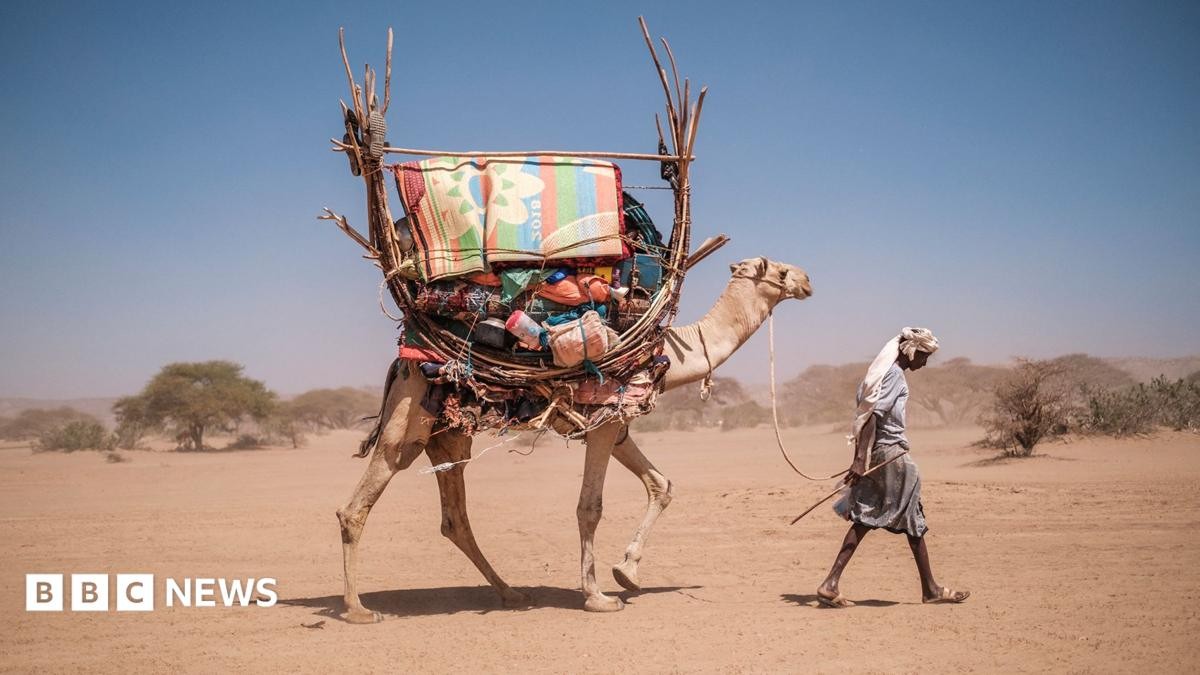
Camels have long been called the ships of the desert. That title assumes the desert is a place your ship can navigate. But in parts of Africa, the heat has changed. It’s no longer just hot. It is hostile. Even the hardiest animals on earth are buckling under the weight of rising temperatures.
Take the Afar region in north-eastern Ethiopia. It is one of the driest, hottest places on the planet. Nomads here drive camel caravans, hauling salt across the burning sand. For Ali Umer, who manages 500 camels in Semera, the change is personal and painful.
“I can see my camels suffering,” he told the BBC.
He sees blisters on their feet. He sees eyes streaming. The hot sand burns their skin, stripping away their hair. But the physical pain is just the beginning. Last month, he lost eight calves to the heat. Eight. That isn’t a statistic; that’s a family.
“Even the wind, which used to bring cool a ir, now carries heat.”
The air doesn’t blow anymore. It presses down.
Umer isn’t imagining things. Scientists, veterinarians, and welfare workers all see the same pattern: stress, dehydration, fatigue, disease. The camels aren’t just uncomfortable; they are dying.
How Climate Change is Turning Camels into Victims
Why are camels dying now when they survived for millennia? The answer lies in the speed and intensity of the current heat waves.
Camels are engineered for heat. They tolerate temperatures up to roughly 40°C (104°F) by letting their body temperature fluctuate. This avoids sweating. Their thick coats block solar radiation. Their urine is concentrated; their droppings are dry. They save every drop of water. It’s a masterclass in survival.
But the planet is pushing past that comfort zone.
In North Africa and the Horn of Africa, which hold 80% of the world’s dromedary camels, the rules have changed. Drought and extreme heat have forced many farmers to switch to camels because cattle can’t handle the conditions. Now, even the camels can’t handle the heat.
Dr. Mohammed Bengoumi with the UN’s Food and Agriculture Organization notes that summer temperatures in the Sahara frequently exceed 50°C. That is beyond biological tolerance.
“In many parts of the Sahara, summer temperatures… increase the risk of severe heat stress,” Bengoumi said.
The heat doesn’t just sit on the skin. It gets inside. Professor Abdelmadjid Chehma, who studies camels in Algeria, found that prolonged heat above 41°C to 45°C attacks cells directly.
The immune system collapses. White blood cells are damaged. They can’t repair themselves. They self-destruct.
Metabolism slows down to reduce internal heat. The animal stops eating. It becomes lethargic. Fatigue sets in. Milk production drops. Reproduction fails.
It is a slow, systemic shutdown.
Which Regions Are Most Affected by Drought and Camel Mortality?
The crisis isn’t uniform, but it is widespread.
Somalia is seeing some of the sharpest declines. A study published in June revealed that drought-related mortality is a widespread crisis. Nearly 46% of camel-ownsing households reported losses. In Sool, the mortality rate hit 73%. That is catastrophic.
Ethiopia mirrors this trend. A 2025 study based on herder perceptions in southern Ethiopia confirmed that climate variability is destroying herd health, productivity, and reproductive performance.
Kenya is feeling the strain too. In Marsabit county, bordering Ethiopia, veterinary officer Hassan Nuya Guyo reports a 15% increase in deaths over the last two years.
“Hyperthermia leads to multiple infections,” he explained. The heat weakens the animals, then infection finishes the job.
Algeria shows clear seasonal spikes. Summer heatwaves are causing significant increases in deaths. Time series analysis shows the pattern is undeniable and accelerating.
“The unprecedented intensity of current heatwaves… is turning this historically resilient animal into a climatevictim.”
Why Veterinarians Are Seeing a Spike in Disease and Mortality
It is not just the heat. It is the heat plus everything else breaking down.
Drought kills the vegetation. Less grass means less food. Less water means less hydration. When you take away the basics, the body fails.
But there is another layer. Inadequate veterinary services. Poor animal management. These factors don’t cause the heat, but they make the heat lethal.
Experts point out that the 2021–22 drought was driven primarily by high temperatures. Extreme heat evaporates water from soil and plants, drying out the environment further. It creates a feedback loop of dryness.
Water prices in some parts of Somalia have risen by 2,000%. Who can pay? The herders are bleeding money and animals at the same time.
The Horn of Africa was already recovering from its worst drought in history (2020–2023). Now, another round of harsh conditions is arriving. Charities like Oxfam warn that the recovery is fragile, shattered by the current heat.
Where Is This Problem Heading for African Livestock?
The World Meteorological Organization tracks this closely. North Africa recorded the most rapid warming of any subregion: 0.43°C per decade between 1991 and 1991.
Countries in the region reported temperatures above 50°C in 2024. That is not a forecast. It is the current reality.
Heatwaves are increasing with a clear upward trend. They are becoming the norm, not the exception.
For herders like Ali Umer, the future looks bleak. He worries an outbreak could hit his adult camels at any time. The young are already gone. The adults are next.
Prof Chehma sees the same end game. Herders are leaving northern regions for good. They can no longer sustain herding there. The heat has rendered the land uninhabitable for this form of life.
Camels were supposed to be the last line of defense against the desert. They were supposed to outlast the droughts.
But the desert has changed. The heat is too intense. The cells are breaking. The milk is drying up. The calves aren’t surviving.
We are watching a climate victim emerge from an animal that was once considered untouchable. What happens when the ship sinks?