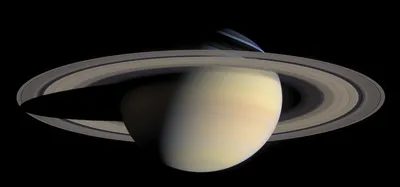
Saturn is the second-largest planet by mass and size in our solar system. It sits as the sixth planet from the Sun. To the naked eye in the night sky, it looks like a steady, non-twinkling star. Point a small telescope at it, though. You will see the rings. They are arguably the most beautiful object in the entire solar system. The symbol for Saturn is ♄.
Why Saturn Spins So Slowly
The name comes from the Roman god of agriculture. We equate him with Cronus, the Greek Titan and father of Zeus (or Jupiter in Roman mythology). Ancient observers knew Saturn was the farthest planet they could see. They also noted it moved slower than any other planet. It takes about 29.5 Earth years to complete one orbit around the Sun. That is because it sits 9.5 times farther away from the Sun than Earth does.
Galileo was the first to look at Saturn with a telescope in 1610. He saw something odd. The resolution was just too low to figure out what he was actually looking at. It took centuries to understand the rings.
The Floating Planet
Saturn is weirdly light. It holds about 60 percent of Jupiter’s volume. But it only has about one-third of Jupiter’s mass. Its mean density is the lowest of any known object in the solar system. It is roughly 70 percent that of water.
Hypothetically, you could put Saturn in an ocean big enough to hold it. And it would float. Both Saturn and Jupiter are mostly hydrogen. This makes them look a bit like stars in terms of bulk composition. Deep inside Saturn, pressure keeps that hydrogen in a fluid metallic state. Similar to Jupiter, but Saturn’s evolution is totally different.
Moons and Origins
Like Jupiter, Uranus, and Neptune, Saturn has rings and lots of moons. These systems might hold the key to how the planet formed. They also help us understand the rest of the solar system.
Take Titan. It is the biggest moon. It has a thick atmosphere. It is denser than those of any terrestrial planets except Venus. That makes Titan unique among all the other moons.
How We Know What We Know
We learned almost everything about Saturn from deep-space probes. Four spacecraft have visited the Saturnian system. Pioneer 11 flew by in 1979. Voyager 1 and 2 followed in the next two years. Then there was Cassini-Huygens.
The first three were quick flybys. They gave us snapshots. Cassini arrived in 2004. It stayed in orbit for years. It studied everything. Its Huygens probe went further. It parachuted through Titan’s atmosphere. It landed on the surface. It was the first spacecraft to touch down on a moon other than Earth’s.
Basic astronomical data
Saturn hangs out far from us. Its mean distance from the Sun is 1.427 billion kilometers. That is 887 million miles. Closest it gets to Earth is about 1.2 billion kilometers. We never see it half-lit. The phase angle—the angle between Saturn, Earth, and the Sun—never exceeds 6°. So, from our vantage point, Saturn is always nearly fully illuminated. To see it sidelit or backlit, you have to go deep into space.
It orbits the Sun like the other giants. Prograde motion. Small eccentricity. Slight tilt to the ecliptic. But Saturn is different from Jupiter in one big way. Its rotational axis is tilted 26.7° relative to its orbital plane.
This tilt creates seasons. Long ones. Each season lasts more than seven Earth years. It also dictates how we see the rings. The rings sit in Saturn’s equatorial plane. From Earth, we view them at opening angles ranging from zero (edge-on) to nearly 30°. The cycle takes 30 years. For about 15 years, we see the sunlit northern side. Then the southern side for the next 15. In the short windows when Earth crosses the ring plane, the rings vanish from view. They are all but invisible.
Solving the Saturn Rotation Mystery
Figuring out how fast Saturn spins was a headache. Its upper atmosphere is massive. Clouds there trace out a variety of periods. Near the equator, it’s about 10 hours and 10 minutes. At higher latitudes, past 40°, it slows down by about 30 minutes. Oscillation. Chaos.
Scientists tried to find the rotation period of the deep interior by looking at the magnetic field. The field is presumed rooted in the metallic-hydrogen outer core. Direct measurement was difficult. The field is highly symmetrical around the rotational axis. Hard to pin down.
During the Voyager encounters, radio outbursts appeared. They were related to small irregularities in the magnetic field. The period measured was 10 hours, 39.4 minutes. That was taken as the rotation period.
Twenty-five years later, the Cassini spacecraft measured the field again. It was rotating 6 to 7 minutes slower. Why the difference? Solar wind is believed to be responsible for some of that drift.
“Not until Cassini flew inside Saturn’s rings on its final orbits was the rotation period accurately measured.”
It took Cassini diving into the rings. It analyzed waves in the ring material and related them to slight variations in Saturn’s gravitational field. The result? 10 hours, 33 minutes, 38 seconds. That is the true rotation period of the planet’s interior. The difference between that number and the cloud tops helps estimate wind velocities.
The Most Oblate Planet
Giant planets lack a solid surface. So, by convention, radius and gravity are calculated at the level where atmospheric pressure is one bar. At that level, Saturn’s equatorial diameter is 120,536 kilometers. Its polar diameter is only 108,728 kilometers.
That is 10% smaller. Saturn is the most oblate planet in the solar system. Flattened at the poles. You can see this even in a small telescope. It rotates slightly slower than Jupiter, yet it is more oblate. Why? Rotational acceleration cancels a larger fraction of gravity at the equator.
The equatorial gravity is just 74% of the polar gravity. 896 cm per second squared at the equator. 1,214 at the poles.
Saturn is 95 times as massive as Earth. But it occupies a volume 766 times greater. Its mean density is 0.69 grams per cubic centimeter. Only about 12% of Earth’s density. It is barely denser than water.
Escape velocity at the equator is nearly 36 km per second. 80,000 miles per hour. Earth’s is only 11.2 km per second. This high value indicates Saturn has not lost significant atmosphere since its formation. It has held onto everything.
By the Numbers
The data paints a picture of a world in constant motion and flux.
- Mean distance from Sun: 1.426 billion km (9.5 AU)
- Eccentricity: 0.054
- Inclination to ecliptic: 2.49°
- Orbital period: 29.45 Earth years
- Visual magnitude at opposition: 0.7
- Synodic period: 378.10 Earth days
- Orbital velocity: 9.6 km/sec
- Equatorial radius: 60,268 km
- Polar radius: 54,364 km
- Mass: 5.683 × 10^26 kg
- Mean density: 0.69 g/cm³
- Equatorial gravity: 896 cm/sec²
- Polar gravity: 1,214 cm/sec²
- Equatorial escape velocity: 35.5 km/sec
- Polar escape velocity: 37.4 km/sec
- Rotation period (magnetic field): 10 hr 39 min (Voyager); ~10 hr 46 min (Cassini)
- Axial tilt: 26.7°
- Magnetic field strength: 0.21 gauss
- Known moons: 274
- Ring system: 3 major rings, myriad component ringlets, several less-dense rings
The Atmosphere of Saturn
Composition and structure. The outer layers have no solid surface. The atmosphere is where the action happens. Cloud motions vary. Wind velocities are estimated by comparing the rotation of the clouds to the rotation of the interior. The difference is the wind.
Saturn looks like a hazy yellow-brown marble from Earth. It’s bland. But that’s a lie. The face you see is a complex mask of cloud layers and small-scale chaos. Red spots. White eddies. Brown bands. These features shift fast. Saturn is basically Jupiter’s quieter, less active cousin.
Until September 1990.
Then a massive light-colored storm erupted near the equator. It grew to over 20,000 kilometers wide. It wrapped around the planet before fading. We call this a “Great White Spot.” It’s the Saturnian equivalent of Jupiter’s Great Red Spot, but it’s rarer. These storms happen every 30 years or so. Since Saturn’s orbit takes 29.4 years, the link is obvious. The storms are seasonal. They follow the planet’s long, slow year.
What’s Inside the Gas Giant?
The atmosphere is mostly molecular hydrogen and helium. The ratio isn’t exact. Helium is hard to measure directly. Best guess? 18 to 25 percent helium by mass. The rest is hydrogen and about 2 percent other junk.
This is weird. The Sun is 71 percent hydrogen and 28 percent helium. Saturn has less helium relative to hydrogen than the star at the center of our solar system. Why? Some theories say helium sank. It settled out of the outer layers and dropped deeper into the planet.
Other molecules show up too. Methane and ammonia are two to seven times more abundant here than in the Sun. We suspect hydrogen sulfide and water are down below in the deep atmosphere. We haven’t detected them yet. But we’ve spotted phosphine, carbon monoxide, and germane from Earth.
These shouldn’t be there. In a hydrogen-rich atmosphere in chemical equilibrium, they vanish. Their presence means they’re coming from deep down. High pressure. High temperature. Reactions happening below the visible clouds. Convective motions drag them up to where we can see them.
The presence of non-equilibrium molecules proves that Saturn’s interior is actively churning material from its deep, hot core up to the visible surface.
Chemistry in the Stratosphere
The stratosphere tells a different story. Acetylene. Ethane. Maybe propane. Methyl acetylene. These are hydrocarbons. They aren’t created by deep heat. They’re created by light. Solar ultraviolet radiation drives photochemical reactions. Or, at higher latitudes, energetic electrons from Saturn’s radiation belts do the work.
Jupiter has a similar setup. The chemistry is consistent across the gas giants. It’s a family trait.
Temperature and Pressure Profiles
Astronomers have measured Saturn’s temperature by watching starlight and radio signals bend as they pass through the atmosphere. This happens when spacecraft fly by or stars occult the planet. We’ve mapped temperatures from one-millionth of a bar to 1.3 bars.
Below 1 millibar, it’s cold and constant. 140 to 150 Kelvin. (-208 to -190 °F).
Dive deeper. Into the stratosphere (1 to 60 millibars). Temperatures drop. They hit a bottom at 82 Kelvin. (-312 °F). That’s the coldest point in Saturn’s atmosphere.
Go deeper still. Temperatures rise again. This is the troposphere. Like Earth’s lowest layer, heat increases with pressure. It’s just gas compression. No heat added or lost. At 1 bar, it’s 135 Kelvin. It keeps getting hotter below that.
The Cloud Decks
The clouds you see are condensation from minor compounds in a hydrogen-rich soup. There’s a haze high up, at 20–70 millibars. That’s from photochemical reactions. But the main clouds start lower. Below 400 millibars.
The highest deck is solid ammonia crystals. They dissolve and disappear at about 1.7 bars. We can’t see the layers below directly. We model them.
Based on chemical models, the next layer down is ammonium hydrosulfide crystals. At 4.7 bars. Deeper still, at 10.9 bars, water ice crystals mix with aqueous ammonia droplets.
Pure ammonia is white. Pure water ice is white. These clouds should be invisible.
But Saturn is yellow, brown, and red. Why? Impurities. Chemical byproducts rain down from above. Photochemical products. Maybe phosphorus-containing molecules act as colorants. The clouds are stained by the atmosphere’s own chemical exhaust.
Blue Shadows and Winter Silence
Saturn tilts on its axis. A lot. This tilt changes everything. The rings cast long, dark shadows onto the winter hemisphere. Sunlight gets weaker. The shadows get deeper.
When Cassini looked at the sunlit strips of the northern winter hemisphere, it saw something unexpected. The atmosphere was blue. Surprisingly clear.
Why? The rings blocked the sunlight. No sunlight means less photochemical haze production. The chemistry slowed down. The sky cleared.
It’s a reminder that Saturn isn’t static. It’s a dynamic, churning world. Layered. Seasonal. Chemical. And occasionally, it just lets you see through the haze for a moment. Then the shadows return. The haze builds up again. You’re left wondering what’s hiding in the deeper, hotter layers we can’t see yet.
The Vanishing Line Between Gas and Liquid on Saturn
You can’t draw a line. Not really.
On Earth, the difference between a gas and a liquid is stark. Water boils. Steam rises. The ocean stays put. There is a boundary. Saturn doesn’t play by those rules. Even deep in its atmosphere, where pressures are extreme, the conditions are off. The minimum temperature sits at 82 Kelvin. That is just too warm for molecular hydrogen to coexist as a gas and a liquid in equilibrium.
This means the shallow, visible clouds you see in telescopes don’t sit atop a hard floor. There is no distinct boundary. The hydrogen doesn’t behave as a simple gas down here, nor does it act like a conventional liquid. It blurs. It transitions. The troposphere stretches tens of thousands of kilometers below those fluffy white tops. It gets denser. It gets hotter.
Unlike Earth, Saturn’s atmosphere doesn’t terminate at a surface. It fades into a supercritical fluid state, becoming steadily denser and warmer as you go deeper.
We talk about planets having surfaces. Rocky ones. Gaseous ones. But this is different. The pressure climbs. The temperature spikes. Eventually, you are looking at thousands of kelvins and pressures exceeding one million bars.
Why does this matter? Because it challenges how we define a planet’s structure. We assume layers. Solid core. Mantle. Atmosphere. Saturn’s hydrogen region defies that clean segmentation. It is a gradient. A continuum. You don’t land on Saturn. You sink into it. And the deeper you go, the less “gas” there is to speak of. Just increasingly dense, superheated fluid.
So where is the bottom? There isn’t one. Not in the way we understand it. The atmosphere just… continues. Until you hit whatever lies beneath. Or until the pressure crushes everything into something we don’t have a name for yet.
Saturn’s weather isn’t just similar to Jupiter’s. It’s a massive, distinct system. The planet is wrapped in zonal flows—east-west winds that create the familiar light and dark bands. But don’t look for high-contrast storms. The features are subtle. The bands are wider near the equator, and the cloud tops have low contrast. You can’t just take a picture from Earth and see much. Spacecraft are required to get the details.
Measuring the Wind
Here’s the problem. Saturn has no solid surface. So how do you measure wind speed? You need a reference point. Scientists use the rotation of Saturn’s magnetic field as the baseline. Relative to that magnetic core, almost everything moves east. The direction of rotation.
The equatorial zone is where it gets wild. Below 20° latitude, you have an eastward flow that hits 470 meters per second. That is 1,700 kilometers per hour. But it’s not constant. Sometimes it slows down by 200 meters per second. It’s a variable beast.
Compare that to Earth. The strongest sustained winds in a tropical cyclone might hit 67 meters per second. Saturn’s equatorial jet moves four times faster. And it’s twice as wide in latitude. It’s not even close.
The Hexagon at the North Pole
Then there’s the hexagon.
It’s at 75° North. The first jet to the south of the northern vortex follows this shape. Cloud features move around it counterclockwise at 100 meters per second. Why a hexagon? It’s probably interacting waves. You see similar angular patterns in buckets of spinning fluids in a lab. But why is it stable? And why did it develop at this specific latitude? Nobody knows.
The symmetry is striking. The zonal flows mirror each other across the equator. A flow at a given northern latitude usually has a counterpart in the south. Strong eastward winds appear at 46° and 60° in both hemispheres. Westward flows, nearly stationary in the magnetic frame, pop up at 40°, 55°, and 70°.
This symmetry has held up for decades. Voyager mapped it. Then Earth-based telescopes improved. They watched Saturn for years. The data agreed with Voyager. The jets are stable. The mechanism keeping them running against atmospheric friction? Still a mystery.
Poles and Pearls
The poles are different. Within 11° of both poles, you find hurricane-like vortices. The south pole vortex has a warm eye. It’s 2,000 kilometers wide. Ringed by clouds that tower 50 to 70 kilometers above the surrounding polar clouds.
Earth’s southern hemisphere storms also have warm eyes and clockwise flow. They ring with high clouds. But scale matters here. Saturn’s version is massive. And crucially, there is no ocean below Saturn’s vortex. No warm water fueling the heat exchange. Just atmosphere all the way down.
Look closer at the mid-latitudes. Near 33.5° North, there’s a “string of pearls.” About two dozen cloud clearings. Each one 1,500 kilometers across. Spaced nearly uniformly across 100° of longitude. In infrared images, they glow bright. Like a necklace stretched across the planet.
Lightning and Deep Currents
The southern hemisphere tells a different story. Cassini detected shortwave radio emissions from lightning storms at 35° South. Intense. Hundreds of times stronger than Earth’s lightning. They last for weeks. Sometimes months.
These storms sit on thick, light-colored clouds. Strong convective motions driven by water vapor. The clearings in the north and the lightning in the south are linked. They sit in zones of fast westward winds. Opposite the direction of most other zonal flows.
What does this mean for the interior? The north-south symmetry suggests the flows are connected deep inside. Theoretical models of a deep-convecting fluid planet show differential rotation aligning along cylinders. Cylinders aligned with the rotation axis.
Saturn’s atmosphere might be built of coaxial cylinders. Each rotating at its own rate. Creating the surface jets we see. These layers don’t start moving together until 9,000 kilometers down. That is much deeper than Jupiter. On Jupiter, differential rotation stops higher up. On Saturn, the currents go deep. And we still don’t fully understand what drives them.
Saturn’s magnetic field is weirdly perfect. It aligns with the planet’s rotation axis to within just one degree. The center of the magnetic dipole sits right in the middle of the planet. This setup resembles a simple bar magnet more than any other planet in the solar system. But there is a catch. The polarity is flipped compared to Earth. Field lines emerge in the northern hemisphere and dive back into the southern hemisphere. If you held a compass there, the needle would point south.
It’s not a pure dipole though. There are subtle deviations. The field shows a north-south asymmetry. The polar surface field is slightly stronger than a simple model predicts. At the one-bar “surface” level, the north pole hits 0.8 gauss. The south pole sits at 0.7 gauss. Earth’s polar field is similar. But the equator tells a different story. Saturn’s equatorial field is 0.2 gauss. Earth’s is 0.3 gauss. Jupiter’s equatorial field is a crushing 4.3 gauss. That is more than 20 times stronger than Saturn’s.
If you model Saturn’s field as a current loop, the magnetic moment is about 600 times that of Earth. Jupiter’s is 20,000 times Earth’s. Why the difference? It comes down to where the field is generated. Saturn’s field comes from fluid motions in its electrically conducting interior. This region consists of fluid metallic hydrogen surrounding a rocky core. It makes up the inner half of the planet. Jupiter has more of this conducting fluid. Less mass and volume in the conducting zone partly explains why Saturn’s field is weaker. Jupiter is also hotter. Hotter interiors mean more vigorous fluid motions. That likely contributes to the massive gap in field strength between the two gas giants.
The Shape of Saturn’s Magnetosphere
The magnetosphere is the teardrop-shaped region of space dominated by Saturn’s magnetic grip. It controls charged particles coming mostly from the Sun. The rounded side faces the Sun. It forms a boundary called the magnetopause. This boundary sits about 20 Saturn radii from the planet’s center. That is roughly 1,200,000 kilometers. But it fluctuates. Solar wind pressure changes the shape constantly. On the opposite side, the magnetosphere stretches into an immense magnetotail. It extends to great distances into space.
Inside this region, things get complicated. The inner magnetosphere traps highly energetic charged particles. Most are protons. They travel in spiral paths along magnetic field lines. These form belts around Saturn similar to Earth’s Van Allen belts. But unlike Earth or Jupiter, Saturn’s belts are leaky. The particles get absorbed by solid bodies orbiting within the field lines. Voyager data confirmed this. There are “holes” in the particle population. These holes exist on field lines that intersect the rings and the orbits of moons.
“Holes” exist in the particle populations on field lines that intersect the rings and the orbits of moons within the magnetosphere.
Titan and Hyperion orbit close to the magnetosphere’s minimum dimensions. They occasionally cross the magnetopause. They travel outside Saturn’s protective bubble. When energetic trapped particles hit neutral atoms in Titan’s upper atmosphere, they energize them. This causes erosion of the moon’s atmosphere. Cassini observed a halo of these energetic atoms around Titan. It is a direct link between Saturn’s magnetic violence and the atmospheric loss of its largest moon.
Auroras and Solar Wind Interactions
Saturn has ultraviolet auroras. These are produced by energetic particles from the magnetosphere impacting atomic and molecular hydrogen in the polar atmosphere. Hubble Space Telescope images from the late 1990s and early 21st century captured these auroral rings. The images provided vivid evidence of the field’s high symmetry. They also revealed how the auroras respond to the solar wind. The Sun’s magnetic field plays a role here too.
The data shows a tight coupling between the sun and the planet. But it is not static. The auroras shift. They react to pressure changes. They follow the magnetic lines. It is a dynamic system. One that we are still learning to read. The holes in the radiation belts remain a mystery of absorption. The asymmetry in the field hints at deep interior dynamics we cannot yet see. Saturn holds its secrets in the spin of its metal and the crash of particles against its rings.
Saturn’s Dense Core and Hydrogen Depths
Saturn’s density is the first clue. It is so low that its bulk composition must be mostly hydrogen. But this isn’t the hydrogen we see in a balloon. Go 1,000 km (600 miles) below the visible clouds. The pressure hits one kilobar. The temperature climbs to roughly 1,000 K (730 °C). At this depth, hydrogen stops behaving like a gas. It turns into a liquid.
It is a strange, highly compressible material. To get Saturn down to its mean density of 0.69 grams per cubic centimeter, you need pressures exceeding one megabar. This happens 20,000 km (12,500 miles) down. About one-third of the way to the center. The planet is essentially a ball of dense, fluid hydrogen holding everything together.
Mapping Gravity to Find Mass
We cannot drill into Saturn. We have to read its gravity field. It is not spherically symmetrical. The planet spins fast. Its density is low. These factors distort its physical shape. They also warp its gravitational field.
Spacecraft data shows this distortion clearly. The motion of probes and the structure of the rings reveal the truth. The shape of the field tells us how mass is distributed. Saturn is more centrally condensed than Jupiter. There is significantly more dense material near the core.
Jupiter’s center is roughly 67 percent hydrogen by mass. Saturn’s is only about 50 percent. The rest is heavier stuff.
The Metallic Transition
Go deeper. Roughly halfway between the cloud tops and the center. The pressure reaches two megabars. The temperature hits 6,000 K (5,730 °C). Something strange happens. The molecular hydrogen undergoes a phase transition. It becomes fluid metallic hydrogen. It looks and acts like molten alkali metal. Think lithium.
The gravity data confirms this region is denser than pure hydrogen mixed with solar helium. Some of this excess density likely comes from helium that settled from the outer layers. But there is more. Saturn may hold material denser than both hydrogen and helium. The total mass could be up to 30 times that of Earth. We cannot pinpoint the exact distribution. However, a rocky and icy core is likely. It probably weighs 15–18 Earth masses. It sits at the very center.
The Magnetic Dynamo
The outer core consists of this fluid metallic hydrogen. It has high electrical conductivity. If circulation currents exist—as expected when heat flows outward and heavier components settle—there is enough dynamo action. This generates Saturn’s magnetic field. The mechanism is the same as Earth’s. Deep field theory applies here.
The deep field near the core is irregular. But what we see from spacecraft is different. It is quite regular. The dipole axis aligns nearly perfectly with the rotation axis. Why the symmetry? Theories suggest the field lines pass through a nonconvecting, electrically conducting region before reaching the surface. This region rotates relative to the field lines, smoothing out the chaos.
We have observed a striking change in the magnetic field’s rotation period over the past 25 years. This shift might be linked to deep electric currents involving the conducting core. The interior is not static. It is moving.
The Internal Heat Mystery
Saturn radiates about twice as much energy into space as it receives from the Sun. This output is primarily at infrared wavelengths between 20 and 100 micrometers. There is a heat source inside.
Kilogram for kilogram, Saturn’s internal energy output is similar to Jupiter’s. But Saturn is less massive. It had less total energy content when both planets formed. If it is still radiating at Jupiter’s level, the source cannot be the same. Something else is fueling this heat.
Saturn’s Internal Heat Engine
Saturn didn’t just fall together. It grew. Calculations of its thermal history suggest the planet started with a heavy core. We’re talking about 10 to 20 Earth masses of material. That core likely formed from ice-rich planetesimals crashing into each other. Once that solid foundation was in place, gravity took over. A massive amount of hydrogen and helium from the early solar nebula rushed in. It collapsed around the core.
Jupiter went through the same dance. It just got heavier. It captured even more gas than Saturn did. That rapid accretion heated up the gas to staggering temperatures. We are talking about tens of thousands of kelvins inside these young planets.
Why Saturn Burns Hotter Than Expected
Here is where the story gets interesting. Jupiter’s internal energy makes sense. It started incredibly hot. It has been slowly cooling for 4.6 billion years. The heat we detect now is just the leftover warmth from that violent birth.
Saturn should have done the same. If it had simply cooled down, its internal heat would have faded long ago. In fact, models show it should have dropped below its current energy output about two billion years ago. But it hasn’t. Saturn is still pumping out heat.
Something else is happening inside.
Helium Rain Drives the Heat
The most likely explanation lies in what is happening deep in Saturn’s interior. Helium is separating from hydrogen. In the metallic hydrogen layer, helium precipitates out of solution. It forms dense droplets. These droplets fall.
It is effectively helium rain.
As these heavy droplets sink deeper, they lose potential energy. That energy turns into kinetic energy as they accelerate. Friction damps the motion. That kinetic energy converts into heat. Convection carries that heat up to the atmosphere. Radiation pushes it out into space.
This process adds extra energy. It keeps Saturn warm longer than simple cooling would allow. Jupiter probably does this too. Its interior is warmer. That allows more helium to stay dissolved in the hydrogen. So the effect is much weaker there.
The Evidence Complicates
The Voyager missions found something that looked like proof. They detected a substantial depletion of helium in Saturn’s atmosphere. This matched the theory perfectly. The helium was sinking, leaving the upper layers thin on the element.
It seemed like vindication.
But the data has since been opened to question. The depletion might not be as clear-cut as once thought. The helium rain theory still stands as the best explanation for Saturn’s lingering heat. But the smoking gun is no longer as obvious as it used to be. The mystery of the extra warmth remains.
A Single Chaotic System
We tend to draw a line in the sand (or ice). On one side, moons. On the other, rings. It feels like a clean separation. It isn’t. Saturn’s rings and its moons are part of one messy, interconnected system. Their structures talk to each other. Their dynamics influence one another. Even their evolution is linked.
Look at the innermost known moons. They don’t sit out in the cold dark. They fall within the rings. Or between them. New moons keep popping up embedded in the ring structure itself. Which raises a weird question: what exactly is a moon?
The ring system is basically a swarm of tiny moons. We’re talking dust specks to car-sized chunks. To house-sized boulders. They all orbit Saturn independently. There is no hard boundary between the largest ring particle and the smallest moon. This makes counting moons a losing game. A precise number may just be impossible.
The Ring System
The rings aren’t static sheets of ice. They are dynamic. Active. Shaped by gravity and collisions. The moons act as shepherds. They keep the rings from spreading out. They also carve gaps. The Cassini Division, for instance, isn’t empty space. It’s a result of orbital resonances with moons like Mimas.
When we look at these rings, we aren’t just seeing debris. We’re seeing a laboratory. A place where physics plays out on a massive scale. Particles collide. They stick. They break apart. The system is in constant flux.
This isn’t just about pretty pictures. It’s about understanding how planetary systems form. And how they stay together. Or fall apart. The lines between moons and rings are blurred. Intentionally? No. Just the result of a chaotic, beautiful dance that’s been going on for billions of years.
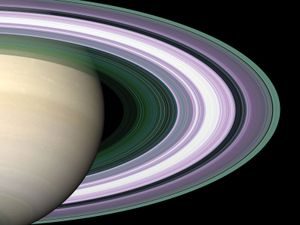
Galileo’s 1610 sighting of Saturn was less a discovery and more a confusion. He pointed his primitive telescope at the planet and reported seeing not one object, but three.
“Saturn is not a single star, but is a composite of three, which almost touch each other, never change or move relative to each other, and are arranged in a row along the zodiac, the middle one being three times larger than the lateral ones.”
He thought he had found a triple-star system.
Two years later, the middle star remained, but the companions vanished. Earth had moved. It had crossed Saturn’s orbital plane, viewing the rings from an edge-on angle. To Galileo’s bewildered eyes, the “appendages” disappeared entirely. When they returned, he still couldn’t piece together the puzzle. He never realized those strange bulges were a disk.
It took the Dutch scientist Christiaan Huygens, working with a significantly better telescope in 1655, to deduce the true shape. He saw the inclined ring plane. He even guessed it was a solid, thick disk.
The Math That Proved They Aren’t Solid
Skepticism grew in 1675. Gian Domenico Cassini, an Italian-born French astronomer, spotted a massive gap in the disk. The Cassini division, as it’s known today, made a solid ring theory look shaky.
Then came the math.
In 1789, Pierre-Simon Laplace proposed the rings were made of many small components. But it wasn’t until 1857 that Scottish physicist James Clerk Maxwell proved it mathematically. The rings could only be stable if they were composed of a vast number of small, individual particles.
American astronomer James Keeler confirmed this deduction about 40 years later.
A Flimsy Structure in Space
Today, we know Saturn’s rings are enormous yet absurdly thin.
- Diameter: 270,000 km (170,000 miles)
- Thickness: No more than 100 meters (330 feet)
- Mass: $1.5 \times 10^{19}$ kg
That mass is only about 0.41 times that of Saturn’s moon Mimas. The entire system, including faint outer rings, spans nearly 26,000,000 km.
But why haven’t the rings clumped together into a moon?
The Roche Limit Explained
Saturn’s rings sit comfortably within the classical Roche limit. This is the closest distance a large moon can approach a planet before tidal forces tear it apart. For Saturn, that limit is about 147,000 km (91,300 miles), or 2.44 Saturn radii.
Inside this zone, tidal forces prevent small bodies from aggregating into larger objects. The rule applies to objects held together by gravity. It doesn’t stop small bodies held together by molecular cohesion. That’s why tiny moons and artificial satellites can persist indefinitely within the limit.
What Are the Rings Made Of?
We can’t see the individual particles directly. Instead, we deduce their size by how they scatter light and radio signals from stars and spacecraft.
The result is a broad, continuous spectrum of particle sizes, ranging from centimeters to several meters. There are significantly fewer large objects than small ones. This distribution matches the expected result of repeated collisions shattering initially larger bodies.
In some areas, collisions are so frequent that even dust-sized grains exist. These grains have short lifetimes. They get electrically charged by sunlight or micrometeorite impacts. This charge interacts with Saturn’s magnetic field, creating moving, wedge-shaped “spokes” that extend radially over the ring plane.
Spokes were common during the Voyager encounters. They disappeared during the Cassini mission until September 2005. The shift likely points to how different sun angles affect the production of charged grains. Some astronomers suggest spokes are seasonal, appearing only around equinoxes.
There is also evidence for larger “ring moons,” bodies several kilometers in diameter embedded in the major rings. Only a few have been detected. These “rubble pile” moons are likely transient, constantly created and destroyed by gravity, collisions, and varying orbital speeds.
The Rings Are Dying
The rings reflect sunlight strongly. Spectroscopic analysis shows they are mostly water ice mixed with darker contaminants.
Because the total mass is so low, the rings are likely very young. They may be between 10 and 100 million years old.
This raises a question: where did they come from?
It is conceivable that the major rings were produced by the breakup of a comet. Alternatively, moons the size and composition of Tethys or Dione might have shattered. The original ring system would have been much larger, shrinking over time to form icy inner moons like Tethys.
But the rings are also disappearing.
Charged material from the rings migrates into Saturn’s ionosphere by following magnetic field lines. Every second, between 432 and 2,870 kg of ring material falls into the atmosphere.
At this rate, the rings will vanish in 292 million years.
That’s a blink of an eye in geological terms. We are living in a brief window of cosmic history, watching a structure that is both magnificent and fleeting. The ice is there. The physics are clear. But the end is already in motion.
The main ring system isn’t just a flat disk. It’s a chaotic, multi-layered mess of structures spanning scales. You’ve got the three broad major rings—C, B, and A—ordered by distance from Saturn. These are visible from Earth. Inside those, there are myriad individual ringlets, some only a few kilometers wide. Scientists use these structures to investigate gravitational resonances. They watch how many small particles interact when orbiting in close proximity.
Many structures have theoretical explanations. A large number remain enigmatic. A complete synthesis is still lacking. Why does this matter? Because Saturn’s rings might be an analogue of the original disk-shaped system of particles out of which the planets formed. Understanding its dynamics and evolution has implications for the origin of the solar system itself.
How Optical Depth Reveals Ring Density
The structure is broadly described by optical depth as a function of distance from Saturn. Optical depth measures how much electromagnetic radiation is absorbed passing through a medium. Think clouds. Planetary atmospheres. Regions of space particles. It serves as an indicator of average density.
A completely transparent medium has an optical depth of 0. As density increases, so does the number. It depends on wavelength and the type of medium. For Saturn’s rings, radio wavelengths of several centimeters and longer are largely unaffected by the smallest ring particles. They encounter smaller optical depths than visible wavelengths.
The Inner Rings: C, D, and the Dense B Ring
The B ring is the brightest. Thickest. Broadest. It extends from 1.52 to 1.95 Saturn radii. Optical depths sit between 0.4 and 2.5. Precise values depend on distance from Saturn and wavelength of light. (Saturn’s equatorial radius is 60,268 km.)
It is separated visually from the outer major ring, the A ring, by the Cassini division. That’s the most prominent gap. Lying between 1.95 and 2.02 Saturn radii, it’s not devoid of particles. It exhibits complicated variations in optical depth with an average value of 0.1.
The A ring extends from 2.02 to 2.27 Saturn radii. Optical depths range from 0.4 to 1.0.
Interior to the B ring lies the C ring. Sometimes known as the crepe ring. It sits at 1.23 to 1.52 Saturn radii with optical depths near 0.1. Inside that, at 1.11 to 1.23 radii, is the extremely tenuous D ring. It has no measurable effect on starlight or radio waves. Visible only in reflected light.
The F Ring and the Outskirts
Exterior to the A ring lies the narrow F ring at 2.33 Saturn radii. Cassini observations suggest a tightly wound spiral structure. Between the A and F rings, distributed along the orbit of the inner moon Atlas, is a tenuous band of material. Probably shed by the moon.
Still farther out is the G ring. Optical depth of only 0.000001. Lying at about 2.8 Saturn radii. Originally detected by its influence on charged particles in Saturn’s magnetosphere. Faintly discernible in Voyager images.
Cassini images from 2008 revealed a small moon named Aegaeon in the G ring. About 0.5 km across. It may be one of several parent bodies. Those rings outside the A ring are analogous to Jupiter’s rings. Composed mostly of small particles continuously shed by moons.
The E Ring and the Massive Phoebe Ring
Beyond the G ring is the E ring. Extremely broad. Diffuse. Extends from 3 to at least 8 Saturn radii. Cassini observations verified it’s composed of ice particles originating from geysers. Ice volcanism, or cryovolcanism. A thermally active region—a hot spot—near the south pole of Enceladus.
Then there’s the outermost ring. Extending from 128 to 207 Saturn radii. Far beyond the others. A vast, tenuous ring of dust. Shed from impacts on the moon Phoebe. It is the largest planetary ring in the solar system.
Discovered by the Spitzer Space Telescope. Observations showed an optical depth of 2 × 10⁻⁸. Unlike other rings, this dust ring shares the same inclination as Phoebe’s orbit.
Other small satellites have tenuous rings too. Or ring arcs. Associated with co-orbital moons Janus and Epimetheus. Methone. Anthe. Pallene.
The system is still not fully understood. We have pieces of the puzzle. The rest remains hidden in the gaps.
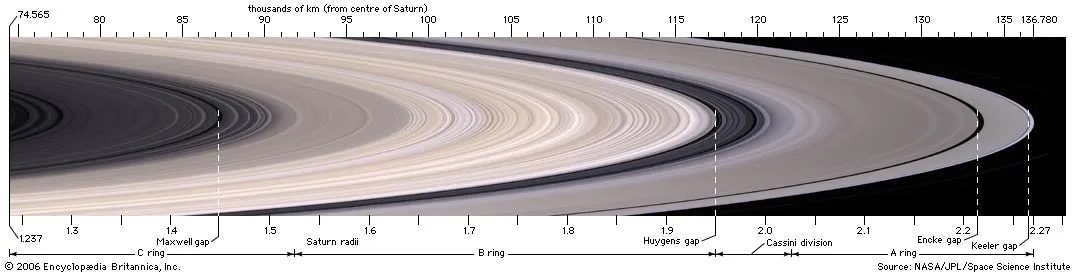
The optical depth in Saturn’s major rings isn’t smooth. It’s fractured. There are massive gaps scattered throughout the C, B, and A rings, some named for the astronomers who first mapped them. We’re talking about the Colombo, Maxwell, Bond, and Dawes gaps inside the C ring. Then there’s the Huygens gap at the B ring’s outer edge, and the Encke and Keeler gaps within the A ring.
Most of these were mysteries until spacecraft got close. The Encke gap was the only one known from Earth before the Voyager missions.
The Moonlet Mowers
Why are they empty? For a long time, it was just theory. Scientists guessed that a moonlet, roughly 10 kilometers wide, was orbiting inside the gap, clearing out the debris with its gravity.
It turned out they were right.
Pan lives in the Encke gap. Voyager snapped it in 1990. Cassini saw it again later, confirming the theory. Then came Daphnis. It was the anticipated shepherd for the Keeler gap. Cassini found it in 2005.
“Daphnis, the anticipated corresponding moon within the Keeler gap, was found in Cassini images in 2005.”
The pattern repeats. Moons may be hiding in the Huygens and Maxwell gaps too. But the real surprise came from the A ring. Cassini detected over 150 moonlets about 100 meters across. They don’t clear big gaps. They leave “propeller” structures in their wakes—tiny disturbances in the ice that betrays their presence. A 400-meter moonlet was even spotted in the B ring, though it doesn’t seem to be carving out a hole.
The Resonance Trap
Sometimes, a moon isn’t in the gap. It’s far away, but its gravity still reaches in.
This happens through orbital resonance. The math is simple. The moon and the ring particles must complete their orbits in a whole-number ratio. If a particle is at a specific radius, it meets the moon at the same spot every time. Over years, those repeated gravitational tugs build up. They push the particle out. The gap forms.
If the moon orbits outside the ring, it takes angular momentum from the particles. It launches a spiral density wave. If the resonance is strong, the gap clears.
Look at the edge of the B ring and the Cassini division. They are in a 2:1 resonance with Mimas. Mimas takes twice as long to orbit Saturn as the particles at that radius. The result? The boundary isn’t a perfect circle. It’s two-lobed.
The outer edge of the A ring is shaped by Janus and Epimetheus in a 7:6 resonance. It’s scalloped with seven lobes.
Resonances explain some of the fine structure. But not all of it. There are thousands of ringlets. We don’t have enough known moons or resonances to explain them all. The system is more chaotic than the models suggest.
The Ring Data
The numbers tell a different story than the theory. Here is how the pieces fit together by radius and width.
| Ring (or division or gap) | Radius of inner edge (km) | Width (km) | Comments |
|---|---|---|---|
| D ring | 67,000 | 7,500 | Faint, visible only in reflected light |
| C ring | 74,490 | 17,500 | Also called Crepe ring |
| (Colombo gap) | 77,800 | 100 | |
| (Maxwell gap) | 87,500 | 270 | |
| (Bond gap) | 88,690 | 30 | |
| (Dawes gap) | 90,200 | 20 | |
| B ring | 91,980 | 25,500 | Brightest ring |
| (Cassini division) | 117,500 | 4,700 | Largest ring gap |
| (Huygens gap) | 117,680 | 285–440 | |
| (Herschel gap) | 118,183 | 102 | |
| (Russell gap) | 118,597 | 33 | |
| (Jeffreys gap) | 118,931 | 38 | |
| (Kuiper gap) | 119,403 | 3 | |
| (Laplace gap) | 119,848 | 238 | |
| (Bessel gap) | 120,236 | 10 | |
| (Barnard gap) | 120,305 | 13 | |
| A ring | 122,050 | 14,600 | Outermost ring visible from Earth |
| (Encke gap) | 133,570 | 325 | |
| (Keeler gap) | 136,530 | 35 | |
| (Roche division) | 136,770 | 2,600 | |
| F ring | 140,224 | 30–500 | Faint, narrowest major ring |
| G ring | 166,000 | 8,000 | Faint |
| E ring | 180,000 | 300,000 | Faint |
| Phoebe dust ring | 7,772,240 | 4,766,000 | Largest planetary ring in solar system, visible in infrared light |
Moons of Saturn
Saturn holds the crown for the most moons in the solar system. The count sits at 274 known satellites. This isn’t just a number. It’s a graveyard of ice, rock, and chaos orbiting a gas giant. We have data for some of these bodies summarized in detailed tables. Names. Traditional numbers. Orbital distances. Physical characteristics. They are listed individually.
The Inner Circle: Small, Fast, and Regular
The first 18 moons discovered all huddle close. Except for Phoebe, which hangs out in the deep freeze of the outer system, they orbit within 3.6 million kilometers of Saturn. That’s 2.2 million miles. Nine of these are huge. Over 100 km in radius. Humans saw them through telescopes before the 20th century ended. The rest? They were pixelated ghosts in Voyager images from the early 1980s.
Then Cassini arrived. Beginning in 2004, it found the tiny ones. Polydeuces is one. Radii of just 3–4 km. Barely noticeable. These inner moons are regular. Their orbits are prograde. Low inclination. Low eccentricity. They behave.
“The eight largest are thought to have formed along Saturn’s equatorial plane from a protoplanetary disk of material, in much the same way as the planets formed around the Sun.”
Pan is a classic example of this regularity. Designation XVIII. It orbits at 133,580 km. Takes 0.575 days to circle the planet. It’s tiny. Radius of 10 km. Mass is negligible at 0.049 x 10^17 kg. Density is low at 0.36 g/cm3. It’s a moonlet carved from the rings.
Daphnis is even smaller. XXXV. Radius of 3.5 km. It orbits at 136,500 km. The mass is poorly known, listed as (0.002). But it matters. It carves gaps. It shepherds ring particles.
Atlas follows at 137,670 km. Radius 19 x 17 x 14 km. It’s not a sphere. It’s a flattened disk. Prometheus and Pandora are the shepherd moons for the F Ring. Prometheus is larger. 70 x 50 x 34 km. Pandora is 55 x 44 x 31 km. Their orbits are close. Prometheus at 139,380 km. Pandora at 141,720 km.
Epimetheus and Janus play a bizarre game. They share orbits. Epimetheus is XI. Janus is X. Their distances are almost identical. 151,410 km vs 151,460 km. They swap positions every four years. A gravitational dance. Epimetheus has a radius of 69 x 55 x 55 km. Janus is bulkier at 99 x 96 x 76 km.
Aegaeon is the smallest of the group. LIII. Radius of 0.3 km. It lives in the G Ring. A pebble.
Mimas is the first big one most people know. I. It has a crater that makes it look like the Death Star. Radius 198 km. Mass is 373 x 10^17 kg. Density is 1.15 g/cm3. It’s mostly ice.
Methone and Anthe are tiny specks. Methone is XXXII. Radius 1.5 km. Anthe is XLIX. Radius 1 km. Pallene is XXXIII. Radius 2 km. They are all small. All regular.
Enceladus is the outlier. II. It defies the “dead rock” model. Radius 252 km. Density 1.61 g/cm3. It has geysers. Water vapor shooting into space. It’s a world that might hide an ocean.
Tethys is III. Radius 533 km. Density is low. 0.97 g/cm3. It’s almost pure water ice. Telesto and Calypso are Trojans. They share Tethys’ orbit. Telesto leads by 60°. Calypso follows. They are small. 15 km across. Rough shapes.
Polydeuces is another Trojan. XXXIV. It follows Dioné. But its orbit is messy. Wide variations. It doesn’t stick to the 60° point like Calypso.
Dione is IV. Radius 562 km. Mass is heavy. 10,970 x 10^17 kg. Density 1.48 g/cm3. Helene is its Trojan moon. XII. Radius 16 km.
Rhea is V. Radius 764 km. It’s the second largest of the inner regular moons. Mass is 22,900 x 10^17 kg.
Titan is VI. The king. Radius 2,576 km. Mass is massive. 1,342,000 x 10^17 kg. Density 1.88 g/cm3. It has a thick atmosphere. Methane lakes. It’s a world unto itself.
The Distant Irregulars: Chaos and Retromotion
Beyond Titan, the rules break. Hyperion is VII. Radius 185 x 140 x 113 km. Its rotation is chaotic. It tumbles. No stable spin. It’s a sponge. Porous.
Iapetus is VIII. Radius 735 km. It’s far out. 3.56 million km. Orbit takes 79.33 days. The inclination oscillates. The moon is two-toned. Dark on one side. Bright on the other.
Then there are the irregular moons. Dozens of them. Small. Distant. Retrograde. They orbit backward. Or at steep angles.
Kiviuq is XXIV. Distance 11,110,000 km. Period 449.22 days. Inclination 45.708°. Retrograde? No, prograde but highly inclined. Radius 8 km. Mass is unknown. (0.033).
Ijiraq is XXII. 11,124,000 km away. Inclination 46.448°. Radius 6 km.
Phoebe is IX. The odd one out in the inner cluster? No, it’s deep in the outer system. 12,947,780 km away. Period is 550.31 days. The ‘R’ indicates retrograde. Inclination is huge. 175.3°. It’s a captured object. Probably from the Kuiper Belt. Radius 107 km. Mass is 83 x 10^17 kg.
The outer swarm continues. Paaliaq. XX. 15.2 million km. Skathi. XXVII. Retrograde. Albiorix. XXVI. S/2007 S2. A provisional designation. No name yet. Bebionn. Erriapus. Siarnaq. The largest of the irregulars. Radius 20 km.
Skoll. Tarvos. Tarqeq. Griep. S/2004 S13. Hyrokkin. Mundilfari. S/2006 S1. S/2007 S3. Jarnsaxa. Narvi. Bergelmir. S/2004 S17. Suttungr. Hati. S/2004 S12. Bestla. Thrymr. Farbauti. Aegir. S/2004 S7. Kari. S/2006 S3. Fenrir. Surtur. Ymir. Loge. Fornjot.
Most of these are small. Radius 2–5 km. Some up to 20 km. Siarnaq is big for a captured object.
Their periods are long. Hundreds of days. Inclinations vary wildly. 33° to 179°. Eccentricities are high. 0.1 to 0.5. They are not part of Saturn’s original formation. They were stolen.
“Quantities given in parentheses are poorly known.”
This note applies to many of these distant moons. We see them. We calculate their orbits. But we don’t know their mass. Or their exact density.
Why This Matters
Why catalog 274 moons? It’s not just bureaucracy. It’s about understanding the
The Distant, Captured Fringe
Look past the orderly inner rings and regular satellites, and you hit a wall of chaos. Starting at roughly 11 million kilometers from Saturn, the solar system’s geography shifts entirely. This is where the “regular” rules of moon-making stop applying. Here lies a second, outer group of moons that don’t play by the book.
Their orbits are defined by what they aren’t. They aren’t circular. They aren’t flat. Instead, these bodies trace highly eccentric, inclined paths around the giant planet. It’s messy geometry. About two-thirds of them move in retrograde fashion, meaning they orbit in the opposite direction of Saturn’s rotation. They are cosmic drifters, spinning against the grain of the system’s angular momentum.
Size-wise, they are puny compared to Titan or Enceladus. Except for Phoebe—a substantial outlier with a radius that dwarfs the rest—these moons are all less than about 20 kilometers wide. That’s small. Tiny, really.
How We Found Them
How did we even see them? Most of these distant, faint specks weren’t visible to Galileo’s telescope or early robotic probes. They required a shift in detection strategy. Beginning in 2000, astronomers started applying new electronic detection methods to the search for fainter objects in the solar system. The goal was simple: find smaller things. The technology allowed them to pick up signals from objects too dim to spot with older techniques.
Some of these discoveries came from Earth-based observatories using those new electronic methods. Others were caught by Cassini, the spacecraft that spent years mapping the Saturnian system. Without Cassini’s close-up eye, and without the improved ground-based sensors, this outer population would likely still be invisible to us.
Captured, Not Primordial
Why does this matter? It changes our understanding of Saturn’s history. These outer bodies appear to be not primordial moons. They didn’t form in place alongside Saturn from the original disk of gas and dust. Instead, they look like captured objects. Or fragments of those objects.
Think about that. A moon that was born elsewhere, perhaps in the Kuiper Belt or further out in the nebula, got pulled in by Saturn’s gravity and stuck. It’s a celestial kidnapping. The irregular orbits are the scar tissue of that capture event. The high inclination and eccentricity are the result of a chaotic insertion into the system.
This suggests Saturn has a complex gravitational history, one where it didn’t just grow its family from scratch. It stole neighbors. It collected debris. The outer ring of moons is less a family and more a collection of refugees.
The Ice Worlds of Saturn
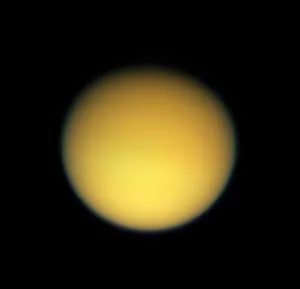
Titan isn’t just big. It’s the only moon in our solar system with clouds, a thick atmosphere, and actual liquid lakes. Its solid body spans 5,150 kilometers (3,200 miles). That makes it second only to Jupiter’s Ganymede in size.
Its density is low. Just 1.88 grams per cubic centimeter. This number tells a story about what’s inside. It’s not just rock. It’s a mix of silicates and ices. The ice is likely water frozen with ammonia and methane.
The air is heavy here. Surface pressure is 1.5 bars. That is 50 percent higher than Earth. Nitrogen dominates. Methane makes up about 5 percent. Traces of other carbon compounds linger in the mix.
For a long time, the surface was hidden. A thick, brownish-red haze choked the view. We couldn’t see much until Cassini-Huygens arrived. The data changed everything.
Titan’s surface is sculpted by processes eerily similar to Earth’s: precipitation, flowing liquids, wind, and even possible volcanoes.
The spacecraft saw a complex topography. Rain falls. Liquids flow. Wind shapes the land. There are impacts, too. And maybe tectonic activity. It’s not a dead rock. It’s an active world.
Then there are the others.
They are much smaller. And mostly airless. Enceladus is the exception. Cassini found water vapor spewing from its south pole. But for the rest? Nothing detectable.
Their density is even lower. Between 1 and 1.5 grams per cubic centimeter. Spectroscopy confirms it. They are ice-rich. Mostly water ice. Sometimes mixed with carbon dioxide or ammonia.
At Saturn’s distance from the Sun, it is cold. Brutally so. The ice behaves like rock. It doesn’t flow or heal. Impact craters stay etched into the surface for eons.
From a distance, they look like Earth’s Moon. Cratered. Grey. Dead.
But that resemblance is superficial. The chemistry is different. The history is different. They are not just rocks wrapped in frost. They are worlds of ice, waiting to be understood.
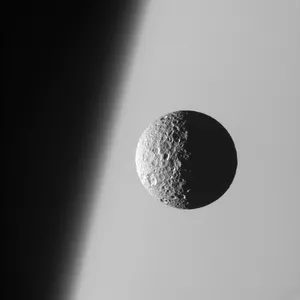
A Moon Scarred by Violence
Mimas looks like it lost a fight with the asteroid belt. Its surface is pockmarked, a chaotic landscape of craters that mirrors the rugged highlands of our own Moon. But there is one feature that makes this icy moon truly unique in the solar system. Not just large. Proportionally massive.
At the center of this chaos sits Herschel crater.
Named after William Herschel, the 18th-century astronomer who discovered Mimas in 1789, this impact site is a testament to sheer kinetic energy. The crater spans 130 kilometers across. To put that in perspective, that is one-third of the entire diameter of Mimas itself. If you stood on the rim, you wouldn’t just be looking at a hole. You would be looking at a third of your world.
The damage is deep. Roughly 10 kilometers down into the crust. The outer walls rise about 5 kilometers high. That is higher than Mount Everest is tall from base to peak.
Why does this matter?
It tells us about the early solar system’s volatility. Mimas didn’t just exist. It survived. A collision of this magnitude should have shattered the moon entirely. Instead, it held together. The geometry of the crater suggests the impact was nearly perpendicular. A direct hit.
We see this same pattern in other icy bodies. Enceladus nearby shows signs of tidal heating, but Mimas remains cold and dead. Its surface doesn’t change. It preserves the scars.
The scale is hard to visualize until you compare it. The crater is so big that the central peak is missing. Or perhaps it collapsed. Or perhaps it was never there to begin with. The walls are steep. Some sections look like they slid down into the void.
This isn’t just a rock with a dent. It’s a warning.
If something this small can take such a hit and keep spinning, what happens when larger bodies collide? The Herschel crater is a frozen moment of violence. It captures the exact second when Mimas nearly died.
We map these craters to date the surface. Older areas have more impacts. Younger areas have fewer. Herschel is ancient. It has been there since the beginning of the planetary clearing phase.
Scientists study the depth-to-diameter ratio to understand the subsurface. Is Mimas solid ice? Or does it have a liquid ocean underneath? The crater’s structure hints at the moon’s internal strength. It held up. Barely.
The next time you look at the Moon, think about Mimas. A tiny, distant world bearing a scar one-third its size.
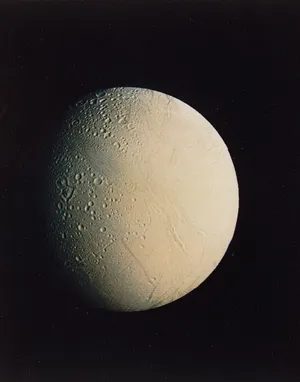
Enceladus is a bright anomaly. Its surface reflects more light than fresh snow on Earth. Voyager images spotted large swathes with almost no big craters. Smooth plains and ridged terrain dominate the landscape. This points to recent internal heat. Melting and resurfacing happened within the last 100 million years. It is geologically young.
Cassini’s spectral data confirmed the ice is nearly pure water. But the real story is at the south pole. There lies a hot spot hitting 140 Kelvin (−208 °F). That is way too hot for just solar heating. The moon hosts “tiger stripes”—strange geological fractures.
These cracks are venting water ice particles into space. The plumes feed Saturn’s E ring. The moon ejects about 1,000 metric tons of material yearly. The particles are tiny. Roughly one micrometre in size. They vanish in a few thousand years due to orbital dynamics. If the ring exists now, the moon must be actively pumping it out. The source is a subsurface ocean. It likely covers the whole moon. Hydrothermal vents probably dot the ocean floor, 30 to 40 km below the surface.
Older, Drier Neighbors
Tethys tells a different story. It is bigger than Enceladus but far less active. The surface is heavily cratered. It looks old. There are subtle signs of creeping ice or viscous flow. But no major resurfacing.
Dione and Rhea are similar. Their surfaces resemble the lunar highlands. Lots of craters. Bright patches suggest exposed fresh ice. Yet Dione shows more recent activity despite being smaller than Rhea. It has resurfaced plains. Fracture systems cut through its crust. Internal heat played a role here too.
The Dark Side of Iapetus
Iapetus is bizarre. Its leading and trailing hemispheres have starkly different reflectivity. The leading side is incredibly dark. The darkest material sits at the apex of its orbital motion. Cassini found carbon dioxide, organics, and cyanide compounds there.
The trailing side is the opposite. It is up to 10 times more reflective. It is heavily cratered and mostly water ice.
Why such a divide? Dark material from the Phoebe dust ring collects on the leading hemisphere. This dark dust absorbs sunlight. The region heats up. Water ice there turns to vapor. The vapor migrates. It condenses and freezes on the cooler trailing hemisphere. The process amplifies the contrast. Iapetus’s low mean density suggests the moon is mostly water ice throughout.
The dynamics governing Saturn’s moons are not static. They are a chaotic, pulsing system of gravitational exchanges that defy simple explanation. Some of these behaviors link directly to the planet’s rings, creating a puzzle that scientists are still trying to solve.
Consider the small moons Janus, Epimetheus, and Pandora. They hang near the outer edge of the main ring system. Gravitational interactions with ring particles push them outward. It is a minuscule force. But it is steady. This exchange of angular momentum does two things. It reduces the spreading caused by collisions in the rings. It also drives the moons into larger orbits.
Here is the problem. These moons are tiny. If this process continued for the age of the solar system, they would be far beyond their current positions. They aren’t. The sharp outer edge of the main ring remains. Inner moons like Atlas stay in place. This supports a troubling hypothesis. The current ring system is much younger than Saturn itself.
The Shepherd Moons
Pandora and Prometheus are the most famous examples of confinement. Voyager 1 captured them orbiting on either side of the narrow F ring. Pioneer 11 had found that ring only a year earlier.
The term “shepherd moon” applies here. These bodies keep ring particles confined to a narrow band. Prometheus acts as the inner shepherd. It pushes the ring outward. This action pulls Prometheus itself inward. Pandora is the outer shepherd. She receives angular momentum from the ring. This pushes the ring inward and drives Pandora outward.
The Cassini mission recorded this clearly. Complex, wavelike bands of particles are drawn out from the F ring as the shepherds pass.
The term shepherd often is used to describe any moon that constrains the extent of a ring through gravitational forces.
This definition is broad. It includes Janus and Epimetheus, whose ring effects were described above. It also includes gap-creating moons like Pan.
Co-orbital Partners
Janus and Epimetheus share the same average orbit. They are co-orbital. Every few years, they approach each other closely. Their gravity interacts. One transmits angular momentum to the other. The recipient moves into a slightly higher orbit. The transmitter drops into a slightly lower one. The process reverses at the next approach.
Not all co-orbitals behave this way. Tethys and Dione have companions too. But Tethys and Dione are massive. There is no significant exchange of angular momentum. Instead, their companions sit at stable Lagrangian points.
Telesto and Calypso lead and follow Tethys by 60°. They are analogous to the Trojan asteroids in Jupiter’s orbit. Helene and Polydeuces do the same for Dione. They lead and follow on average.
Resonance and Heat
Several moon pairs exist in stable dynamic resonances. They pass one another periodically. Their orbital periods relate in small whole numbers.
Take Hyperion and Titan. Titan orbits in 15.94 days. Hyperion takes 21.28 days. The ratio is roughly 4:3. Titan completes four orbits while Hyperion completes three. They always pass closest at Hyperion’s apoapse—the farthest point of its elliptical path.
Titan is more than 50 times more massive than Hyperion. It transmits the most momentum at the same points in Hyperion’s orbit. These periodic “shoves” force Hyperion into a relatively elongated, eccentric orbit.
This matters for geologic evolution. Resonances can force orbital eccentricities to large values.
Ordinarily, tidal interactions reduce eccentricity. Saturn’s gravitational pull deforms nearer moons cyclically. This braking effect causes synchronous rotation. The moon rotates at the same rate it revolves. The same hemisphere always faces the planet. Earth’s Moon does this. So do several of Saturn’s inner moons.
When a moon rotates synchronously, deformation is stationary in its reference frame. Frictional heating stops.
But resonance changes everything. A moon forced into an eccentric orbit by resonance experiences tidal interaction even in synchronous rotation. It travels alternately farther from and closer to the planet. The deformation becomes dynamic. It generates heat through internal friction.
Jupiter’s Io is the extreme example. Resonance with Europa forces it into an eccentric path. Io is the most volcanically active body in the solar system.
Saturn’s moons likely follow a similar logic. If resonances maintain their eccentricities, they may still be heating up internally. The question is whether we can detect that heat. Or if the rings’ youth suggests the system reset entirely, wiping out any previous thermal history.
The Hidden Heat of Saturn’s Moons
Current models show that tidal forces aren’t doing much heavy lifting for heating Saturn’s moons right now. The math just doesn’t add up. But the past tells a different story. Back then, the friction might have been significant. It’s a reminder that these celestial bodies change. They cool. They shift.
Take Enceladus. Its southern pole is a different matter entirely. The famous “tiger stripes” are wide fissures. They spew icy material into space. This debris forms the diffuse E ring. The moon orbits within that ring. The connection is direct.
Scientists are still trying to pin down the exact cause of this thermal activity. The fissures are hot. Too hot for simple radiogenic decay. The leading theory points to tidal deformation. Even if the current heat is low, the mechanical stress of Saturn’s gravity on the moon’s crust is likely the engine. It flexes the ice. That friction generates heat. It keeps the subsurface ocean liquid.
The tiger stripes are the present-day source of the icy material for the diffuse E ring.
This isn’t just about pretty rings. It’s about habitability. If tidal forces were stronger in the past, those moons might have been warmer for longer. The conditions for life could have existed when they didn’t now. We are looking at a geological timeline. Not a static snapshot.
The question remains whether we can detect this ancient activity. The surface geology offers clues. Cracks. Smooth plains. Resurfacing events. It all points to a dynamic interior. Saturn’s gravity is a tugging force. It never stops. It just changes intensity. Understanding this helps us predict what other moons might look like. Closer to their planets. Warmer. More active.
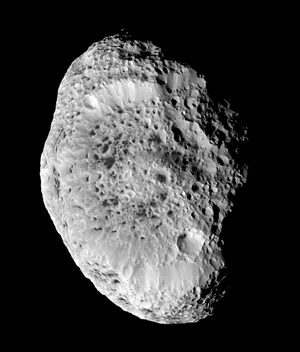
Hyperion breaks the rules. Most moons in the solar system lock into synchronous rotation because tidal forces drag their spins into step with their orbits. Hyperion refuses to comply. Its eccentric orbit and bizarrely nonspherical shape create a messy tug-of-war between its spin and orbital angular momentum. The result is chaos. Mathematically speaking, it’s unpredictable.
Voyager saw it spinning nonsynchronously at a period of about 13 days. That was just a snapshot. Apply chaos theory to that data, mixed with later Earth-based observations, and you see the real picture. Hyperion is tumbling. It’s the only known object in the solar system rotating in a chaotic manner. You can’t predict where it will be facing next.
Seeing Saturn from the Ground
Even with perfect conditions on Earth, telescopes can’t resolve features on Saturn smaller than a few thousand kilometers. Before spacecraft flew by, we knew almost nothing about the fine detail in the rings or atmosphere.
The Encke gap in the A ring is a good example. Johann Franz Encke reported it in 1837. For over a century, people doubted it existed. It wasn’t until 1978 that Harold Reitsema confirmed it. He used measurements of an eclipse of the moon Iapetus by the rings to get better resolution than normal Earth-based methods allowed.
Modern Earth-based research uses tricks. Infrared spectroscopy reveals the composition and thermal balance of the rings, atmosphere, and moons. You can also get kilometer-scale resolution by watching bright stars pass behind the planet. Occultation. In 1989, Saturn and Titan both occulted the bright star 28 Sagittarii. It let astronomers see ring and atmospheric structures with a clarity not seen since Voyager.
Then there was the 1990 Great White Spot. Surface telescopes and the Hubble Space Telescope watched it. Hubble was above the distorting effect of Earth’s atmosphere. Clear data. In 1995, Earth passed through Saturn’s ring plane. The edge-on view let us determine ring thickness directly. It also allowed for a precise measurement of the rate of precession of Saturn’s rotational axis.
The Pioneer and Voyager Missions
Pioneer 11 was first. Launched in the early 1970s, it was originally heading to Jupiter. Mission scientists didn’t plan a Saturn stop. But Jupiter’s gravity helped them retarget the probe. They swung it around and sent it flying toward Saturn.
In 1979, Pioneer 11 passed through the ring plane. It got within 38,000 km (24,000 miles) of the A ring. It flew within 21,000 km (13,000 miles) of Saturn’s atmosphere. Close enough to feel the heat, probably.
Voyager 1 and 2 followed. Launched in 1977, they were also aimed at Jupiter initially. These twin probes carried much more elaborate imaging equipment. They were built for multiple-planet flybys. Specific scientific objectives at each destination.
Like Pioneer, they used Jupiter’s mass for gravity-assist maneuvers. This redirected their trajectories to Saturn. Voyager 1 arrived in 1980. Voyager 2 in 1981. Together, they returned tens of thousands of images of Saturn, its rings, and its moons. The data was overwhelming. Detailed. Real.
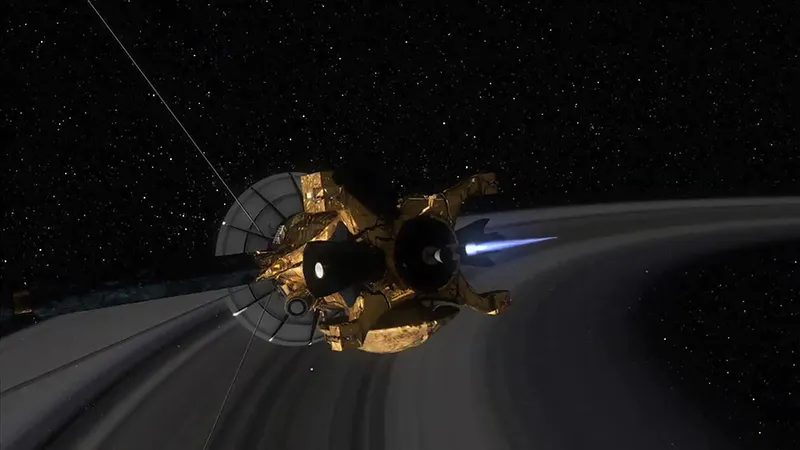
The Cassini-Huygens mission wasn’t just a trip to Saturn. It was a twenty-year diplomatic and engineering feat involving NASA, ESA, and ASI (Italy). Launched in 1997, the spacecraft didn’t take a straight line. It took a cosmic shortcut.
Gravity assists from Venus, Earth, and Jupiter slingshotted it toward the outer solar system. By 2004, it arrived. The craft weighed nearly six metric tons with fuel. It was one of the heaviest, priciest, and most complex machines humans had built up to that point.
But the hardware was only half the story.
A Two-Part Mystery
The mission split into two distinct personalities.
Cassini orbited Saturn. It studied the rings, the planet’s atmosphere, and the icy moons.
Huygens detached. It descended through Titan’s thick, orange atmosphere. It didn’t have a parachute for the whole ride, but it landed softly on a solid surface in January 2005.
For three hours, Huygens sent data back. Images. Chemical readings. Cassini caught the signal and beamed it to Earth. Scientists watched in real-time as humanity touched the ground of a distant moon for the first time.
Why the End Was Planned
We often think of space missions ending because they run out of fuel or break down. Cassini’s end was different. It was a choice.
By 2017, the fuel was gone. The spacecraft was also dangerously close to moons that might harbor life. Titan had liquid lakes. Enceladus had geysers shooting water ice into space from its south pole. These were prime candidates for extraterrestrial biology.
If Cassini crashed into either moon by accident, Earth bacteria could have contaminated them. Scientists needed to be sure.
So they steered the probe into Saturn.
The Final Descent
In its last months, Cassini didn’t stay far away. It dove into the planet’s upper atmosphere. It skimmed the gap between Saturn and its rings. It measured gravitational and magnetic fields with unprecedented precision.
Then it entered the atmosphere. The heat and pressure destroyed it.
This wasn’t a failure. It was a quarantine protocol.
By destroying Cassini, NASA ensured that Titan and Enceladus remained pristine. If we ever send life-bearing probes there in the future, we won’t be carrying Earth’s ghosts with us. We’ll have a clean slate.
The mission ended not with a crash, but with a controlled sacrifice. A final act of planetary protection.
What We Learned
The data collected over 13 years changed our understanding of the solar system. We saw weather patterns on Saturn that rivaled Earth’s storms. We mapped the intricate structure of the rings. We confirmed that Titan’s lakes are made of methane and ethane. We found that Enceladus has a subsurface ocean.
These discoveries suggest that life-supporting environments might be more common than we thought. Not just on rocky planets near a star, but in the icy darkness of the outer solar system.
Cassini gave us a glimpse of a world that doesn’t look like Earth. But one that behaves with similar complexity.
The spacecraft is gone. The data remains. And the question