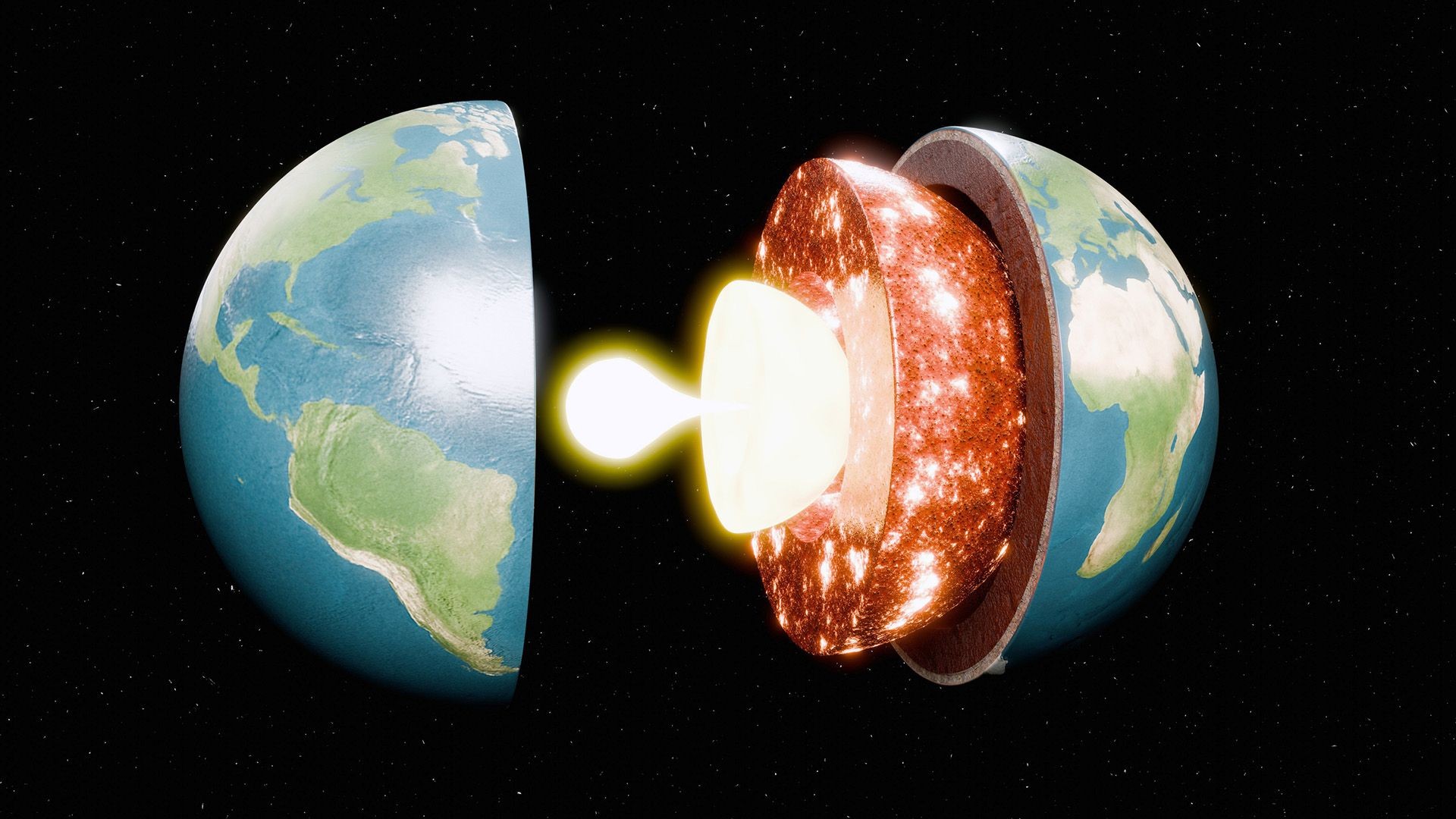
Hotter. You wouldn’t expect it down there in the dark, under miles of rock, but Earth’s core burns fierce. Roughly 4.5 billion years back, the planet was just a molten lump. Heavy stuff—iron and nickel —sank to the bottom. Gravity did the sorting.
What’s left at the center today is dense and furious.
Two layers of heat
The core isn’t one blob. It splits into two zones. First, the liquid outer core starts about 1,800 miles beneath your feet. It stretches for another 1,400 or so. Then comes the solid inner core. That beast sits deeper, beginning at 3,200 miles down. Its radius? About 758 miles.
So. How hot?
Scientists put it at the boiling point of a star’s surface. We are talking 9,000 to 10,00 degrees Fahrenheit (about 5,000–5,500°C). That’s the boundary between the inner solid sphere and the liquid ocean surrounding it.
Did we drill there? No.
You can’t drive a core sample that deep. Instead, they guessed. Educated guesses. The math comes from squeezing iron in labs until it mimics the crush of the deep earth. They look at meteorites, too, analyzing their composition for clues about what our planet is made of.
Seismic waves help. When they zip through the Earth, they bend. Sometimes they vanish. Those shifts tell physicists the core is mostly iron—around 85% of it—with some lighter alloy partners mixed in.
Here’s the twist on temperature.
On the surface, iron melts at 2,800°F. Sounds manageable, right? Not under pressure. Quentin Williams, a physicist at UC Santa Cruz, points out the “enormous pressures” inside. High pressure raises the melting point. So even though the inner core is screaming hot, it stays solid because the weight on top is crushing it together. It’s a paradox. Solid ice-hot rock.
To prove it, scientists use diamond anvil cells. They pin a speck of iron between sharpened diamonds. Then they hit it with lasers. Other folks blast iron with shock waves, trying to replicate that deep-Earth crush. The data gets plotted. Extrapolated. The numbers land on that 10,00-degree range.
“To some extent,” Shichun Huang of Sun Yat-sen University admits, “what we know… is all an educated guess.” Crystallization patterns? Still a mystery.
Leftover fire
Where does the heat come from? Old news, mostly.
When Earth coalesced, gravity pulled everything in tight. That potential energy turned straight into heat. Huang says. Then a Mars-sized rock crashed into us. Boom. More heat.
Radioactive elements might help, too. Potassium, uranium, thorium —these decay over time and release warmth. Though, whether they exist down there is debated.
The point is, we didn’t cool down like the other rocky neighbors in the solar system did. Williams puts it bluntly.
“We’re not really good at planet cooling.”
We held onto our primordial fire.
Why do you care? Because without that heat, the magnetic field dies. The liquid iron churning in the outer core generates the shield that blocks lethal solar winds. Also, plate tectonics moves. Shelves shift. Nutrients bubble up. Life finds a way.
“If you care about life, you should look at the inside,” Huang says.
We are surviving on the back of a blistering furnace we can never visit. It churns. It shields. We just stay above it, pretending it’s normal.