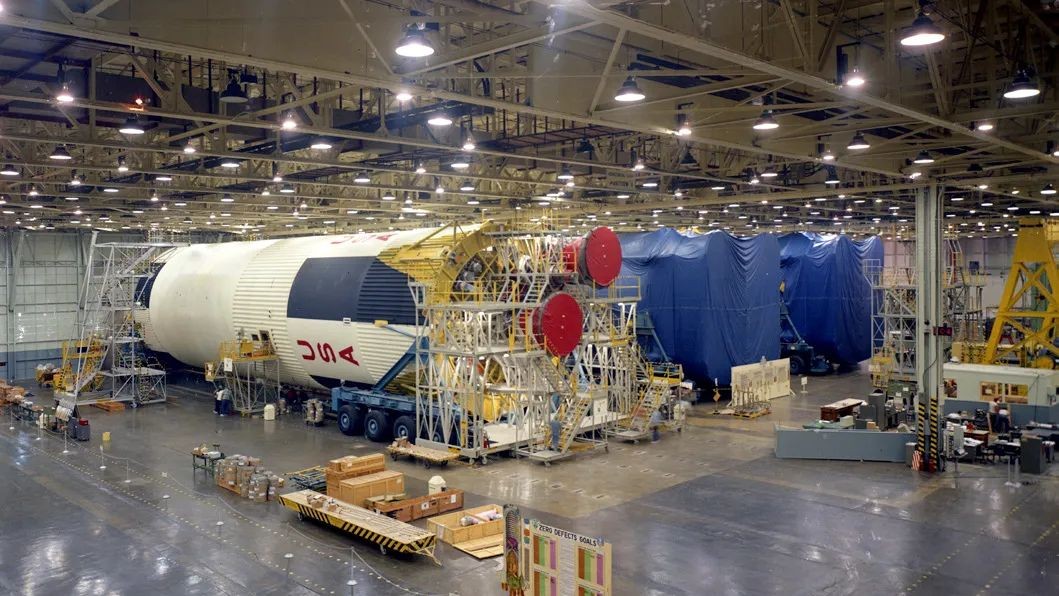
On Aug. 1, 19 68, NASA made a call that still feels strange looking back. They ended production of the Saturn V moon rocket.
This wasn’t because the machine broke. It wasn’t because they lacked the will. It was because the money ran out.
The giant booster had already done what no other vehicle could. It carried astronauts beyond low-earth orbit. It stood as the largest, most powerful rocket in history. But the U.S. government needed cash for other things. Specifically, the Vietnam War was getting expensive. Congress looked at the budget deficit and slashed nearly 75 percent of the funding President Lyndon B. Johnson had earmarked for the Apollo program.
That cut hurt.
By the time the decision landed, the first moonwalk was still almost a year away. Apollo 11 wouldn’t touch the lunar surface until July 1969. Yet NASA already knew the line would end there.
How the Saturn V Program Shrank
NASA built fifteen Saturn V rockets in total. They flew thirteen of them. Two remained on the pad.
The last one to launch in 1973 wasn’t meant for a moon landing. That flight had originally been assigned to Apollo 18. But the program was already being trimmed. Too many missions, not enough budget. So they redirected the booster to launch Skylab. America’s first space station went up on that final giant launch.
Think about that timeline. The Apollo 11 astronauts walked on the moon in July 1969. Production stopped in August 1968. The agency killed its primary tool while the most famous mission of all was still being planned.
Without a steady supply of heavy-lift rockets, NASA couldn’t just keep going. They had a limited stockpile. The final Saturn V to carry astronauts flew in 1972 with the Apollo 17 crew. That was the last moonshot.
It took more than five decades for another rocket of that caliber to launch. The Space Launch System finally broke ground on Artemis I in 2022. By April 2026, it carried Artemis II astronauts on a flyby.
The True Cost of Going to the Moon
You have to look at the ledger to understand why this happened. NASA spent approximately $9.4 billion on the Saturn family of vehicles.
That number includes the smaller Saturn I and Saturn IB stages. It covers all development, all launches. In today’s dollars, that’s about $118 billion.
That is a massive sum for a program that lasted less than a decade.
The decision to shut production down in 1 968 over costs spelled the end of the Apollo moon program a year before Apollo 11 landed.
It sounds like a rational fiscal choice. Cut spending where it hurts the least. But it meant grounding the moon program prematurely. Or at least, forcing it to use every last inch of remaining fuel in the pipeline.
The final Saturn IB, not the big V, launched the Apollo-Soyuz test project in 1975. A joint mission with the Soviets. A handshake in orbit. It was a neat bow on a chaotic decade.
But the big rockets? Gone.
For 54 years, there was nothing comparable. We built commercial crew vehicles. We built reusable boosters. But we didn’t have a direct replacement for the Saturn V moon rocket. Until now.
Artemis is bringing them back. Slowly. Expensively. The budget battles haven’t vanished; they’ve just moved to a different stage. The political will has shifted, too.
Does the world really need another moon mission?
Probably yes. But will it get the same giant rocket? Or will they try to build something cheaper, faster, and less powerful?
That remains to be seen. The Space Launch System is heavy, yes. But is it the successor to Saturn V, or just a different answer to a different question?
We won’t know until the engines fire again.