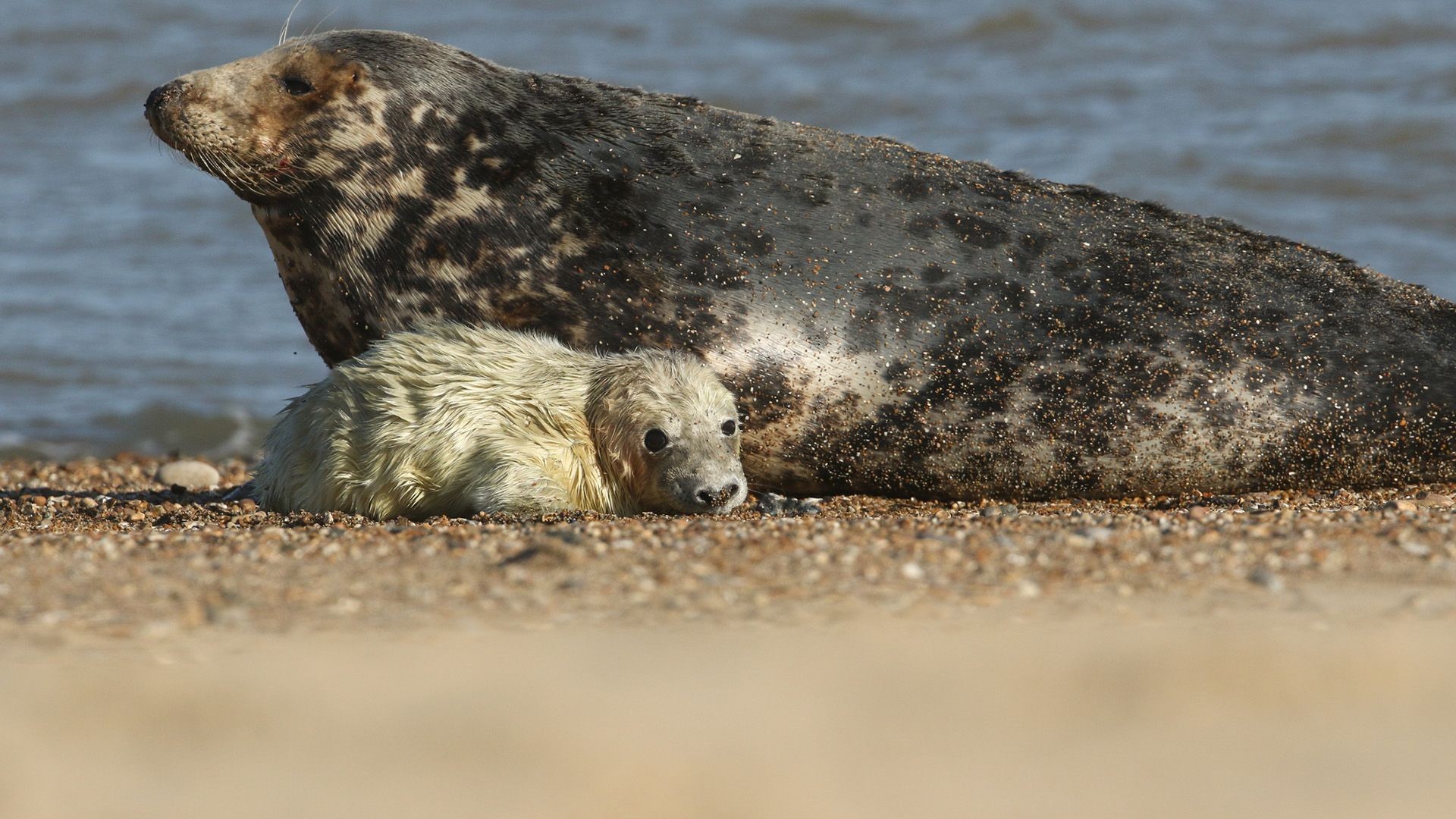
Pups were dying on a Canadian island. Mysterious deaths. Corkscrew wounds. Scientists thought sharks were the culprit for years.
They were wrong.
The killers are male gray seals.
And they are eating their own.
The Mystery of the Spiral Wound
For over three decades, these injuries plagued the colonies on Sable Island. The marks were distinctive. Spiraling. Deep. Like a drill had gone through them.
In 1992 researchers first documented this kind of cannibalism in Nova Scotia. Scotland followed suit in 2016 with direct observation proving males were eating pups. But Sable Island remained stubbornly silent. No one saw it happening there. No evidence linked the specific spiral wounds to local seal predation.
Until now.
Eye-Witness Account
The breakthrough happened in 2024. An adult male attacked a pup on Sable Island and someone saw it.
The research team didn’t just rely on that sighting though. They went hunting for answers. They examined the skin and blubber of dead pups. The bite marks matched gray seal teeth. The claw marks fit too.
The findings landed in the Marine Mammal Science journal in early February. The team also re-reviewed drone footage from 2023. It was conclusive. Between 2023 and 2025 adult male gray seals were actively feeding on pups.
The numbers were staggering. In the 2024 alone 765 pups had those spiral scars. In a single day during 2025 scientists found 359 dead pups.
A spike? Maybe not necessarily. It’s more likely that they just started looking properly. When you know what you’re looking for the body count goes up.
So Who Did We Blame?
“We were certainly relieved to have an answer,” says Damian Lidgard.
He’s a biologist at Fisheries and Oceans canada and part of the study team. For years the default assumption was shark predation. Sharks make nice clean cuts sometimes but never were sharks observed doing this at Sable Island.
Given the pattern elsewhere in Europe the shift in hypothesis wasn’t a surprise. Just a long time in coming.
Does It Matter?
Should we panic?
Probably not.
Lidgard notes the island produces roughly 75 000 pups every year. The toll from cannibalism? Under 1 000 deaths.
The math doesn’t point to a collapse. It’s a dent. Not a death blow.
There are no alarms blaring.
But there is a worry.
It’s not the gray seals themselves who are the main concern. It’s who else they might target.
Male gray seals in Europe kill harbor seal pups. Harbor seals also live on Sable Island. Their numbers are small. They have been declining for decades. If the local males start turning their attention there it could be disastrous.
“Harbour seal pup production is very small,” Lidgard says. “Potentially concerning.”
Ursula Siebert a researcher at the University of Veterinary medicine Hannover agrees. She notes gray seals are opportunistic hunters of marine mammals generally. If they see an easy target they’ll take it.
The Why Question Remains Empty
So why are they doing it?
We don’t know.
It’s frustratingly unclear. It might just be natural male behavior finally getting documented. It could be learned.
But that seems unlikely.
The populations on Sable Island and the UK are isolated genetically and behaviorally. It’s rare for two separate groups to invent the same specific violent habit at the same time by chance.
Hypotheses abound. The data is sparse.
Maybe they’re hungry. Maybe it’s stress. Maybe it’s just what big aggressive male seals do when bored.
Or maybe we still haven’t seen enough.
The wounds remain. The seals keep eating. And we’re left with a picture that’s only half drawn.