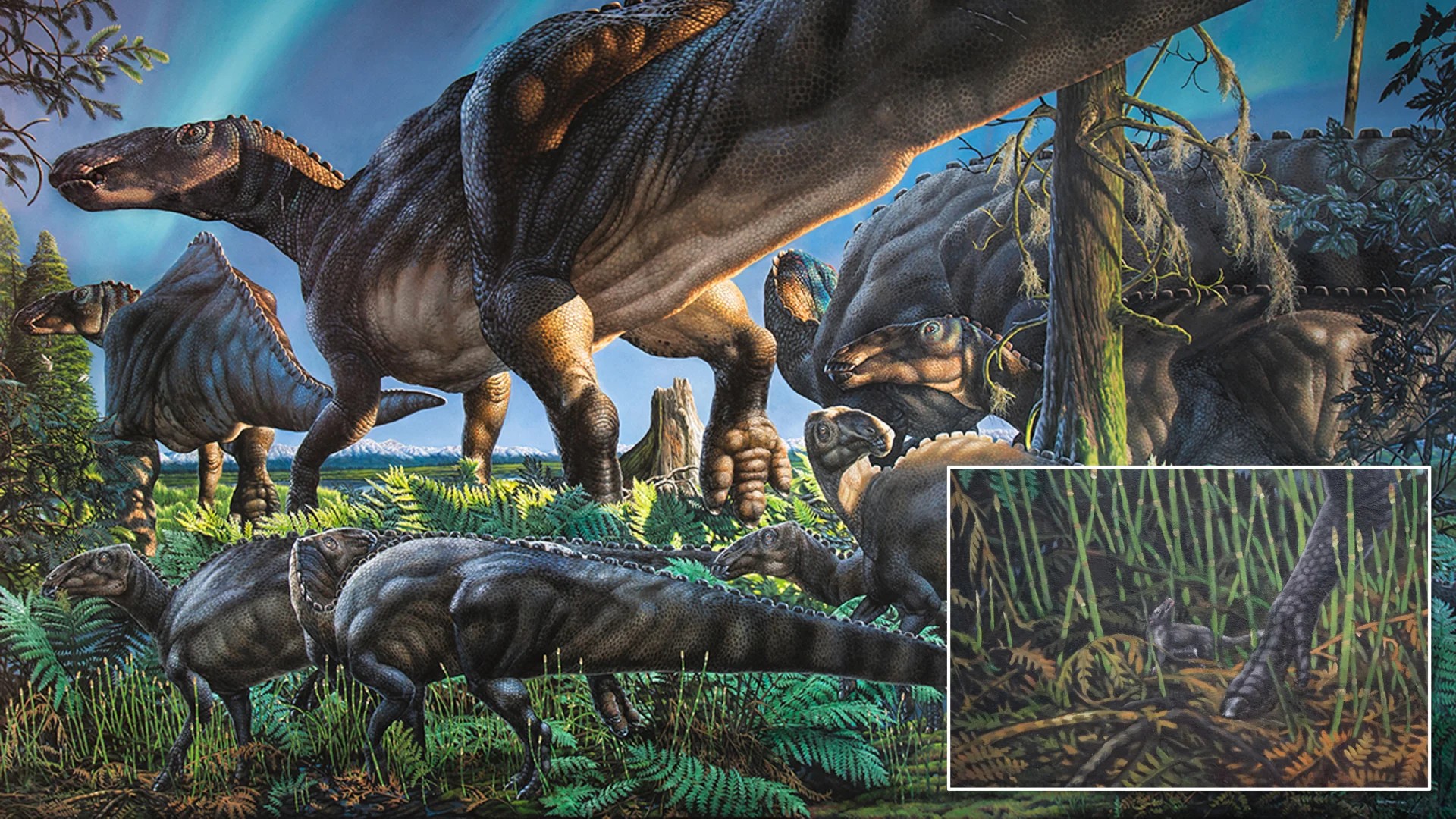
Tiny teeth are rewriting history. Again.
Look at the Arctic today. It’s harsh. Cold. Desolate. Not exactly a biological hotspot. But seventy-three million years ago? Different story. A lot of life happened up there.
A new study published in Proceedings of the National Academy of Sciences flips the script. Scientists from CU Boulder and elsewhere found three previously unknown mammals in northern Alaska. Rodent-like things. They lived during the age of dinosaurs. And they didn’t just survive the dark winters and freezing temps, they thrived.
It suggests the Arctic wasn’t an isolated dead zone. It was a crossroads.
“The polar regions were still very active places for life.” – Sarah Shelley
Three New Cousins
The fossils are old. Ancient. But they’re distinct. The team named them after their looks and habits.
- Camurodon borealis . “Northern curved-tooth.” A herbivore.
- Qayaqgruk peregrinus . “The little wandering hero.” Named for an Alaskan Inuit legend.
- Kaniqsiqcosmos polaris . “Polar frost ornamented tooth.”
Found in the Prince Creek formation, inside the Arctic Circle. Months of winter darkness. Food shortages likely. Freezing cold.
Did they cope? Yes.
These creatures belong to a group called multituberculates. Think mice or rats in size. They lasted for over 100 million years. Jurassic to Eocene. They survived the asteroid that killed the dinosaurs. Homo sapiens have only been around for 300,00 years.
That’s not resilience. That’s a superpower.
Diet Defines Survival
Why did they last so long? Their teeth hold the clue.
Different shapes meant different food. C. borealis chewed plants. Q. peregrinus was an omnivore. Probably ate insects and greens. K. polaris seemed to prefer plants too but was flexible.
In a landscape where food is scarce, specialization isn’t a luxury, it’s a necessity. Being able to eat different things allows species to share the same space without starving each other out. It might explain how they tanked the asteroid impact too.
“Deep time reminds us that a space is a layered history.”
Crossing the Ice
Here is the twist. One of these creatures didn’t start here.
Qayaqgruk peregrnus is a close cousin of a mammal found in what is now Mongolia.
This means migration. From Asia to North America. About 92 million years ago. That makes it one of the earliest recorded intercontinental moves for mammals. There was a land bridge. A corridor. It wasn’t a static map back then, it was a highway.
Scientists have always assumed the tropics drive evolution. The Arctic just waits it out.
Wrong.
The Arctic was active. Diversifying. Adapting. These little mammals proved that the poles weren’t just cold edges of the map. They were centers of innovation.
And now the climate is changing again. Maybe looking back at how mammals survived polar stresses isn’t just about the past. Maybe it tells us something about the future.
The fossils are quiet, but the implication is loud. The Arctic was never really empty. We just stopped listening.