It was smaller than you think. Only a meter across the wings, roughly three and a half feet.
That doesn’t sound impressive next to Quetzalcoatlus, the giant pterosaurs that looked like they could lift small planes. But Laueropterus vitriotus is big for its specific group. The monofenestratans. An early batch of pterosaurs.
These creatures were the pioneers of vertebrate flight, hitting the sky about 210 million years ago. They started tiny. Sparrow-sized, mostly. Then they exploded in variety. From mini to monster. This new find sits in that awkward transitional spot between the early experiments and the sleek, late-period pterodactyloids.
Found in Bavaria. Germany. 2007, to be precise. The Schaudiberg quarry holds secrets, mostly locked in limestone. This specimen comes from the Mörnsheim formation. Late Jurassic, so we’re looking at a fossil between 143 and 150 million years old.
It’s rare, too. Not just rare as in hard to find. Rare in how it breaks down. The bone structure mixes old and new tricks.
“Laueropterus marks the fourth non-pterod actyloid monofenest ran from Mühlheim…”
Dr. David Hone from Queen Mary University of London wrote the study, published recently in PeerJ. He’s excited, mostly because the math is weird. In the famous Solnhofen beds—the usual hotspot for Jurassic fossils—scientists have pulled up hundreds of specimens. And found Propterodactylus once. Maybe.
In Mühlheim? Less than a dozen pterosaurs recovered in total. And four of them are these transitional monofenestratans? Laueropterus is just the latest name in a local cluster including Skiphosoura and Makrodactylus. That’s a dense pack. The other region stays quiet. Mühlheim talks loud.
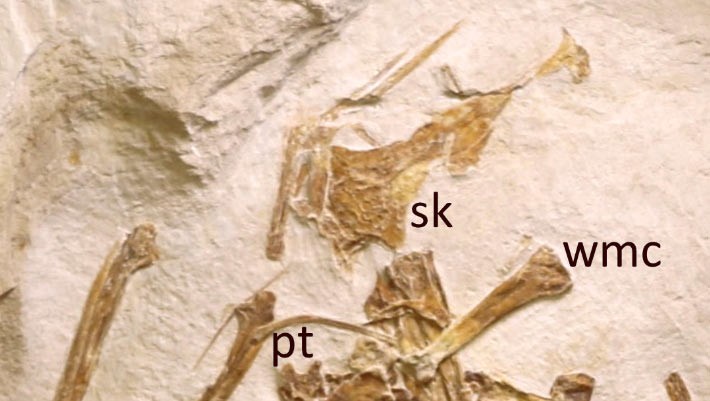
The preservation is good. Too good to ignore. A slab of limestone, gray with white streaks running across it. The skull, jaw, spine, and wings are intact. Undistorted. Even the thin sternal plates are visible underneath the wing bones. No crushing, no mess.
But it’s the mix of features that sticks out. It has the monofenestratan trademark: a big skull where the nostril hole and the eye-opening hole merged into one single hole. Primitive trait, really. But the wing bones are short. Shorter than later species. It looks like the lineage hadn’t quite streamlined itself yet.
Why here? Why this concentration of “not-quite-modern” pterosaurs? Hone calls it notable. A distinct presence. Most researchers assume these groups disappear or evolve quickly, but this rock layer disagrees.
Maybe they lived differently here. Or maybe the death traps were different. We don’t know for sure. We just have a fossil, beautifully preserved, showing us a bridge across time that we hadn’t fully noticed until now.
One more hole in our story fills in. But the sky above 150-million-year-old Bavaria remains vast, empty of sound.