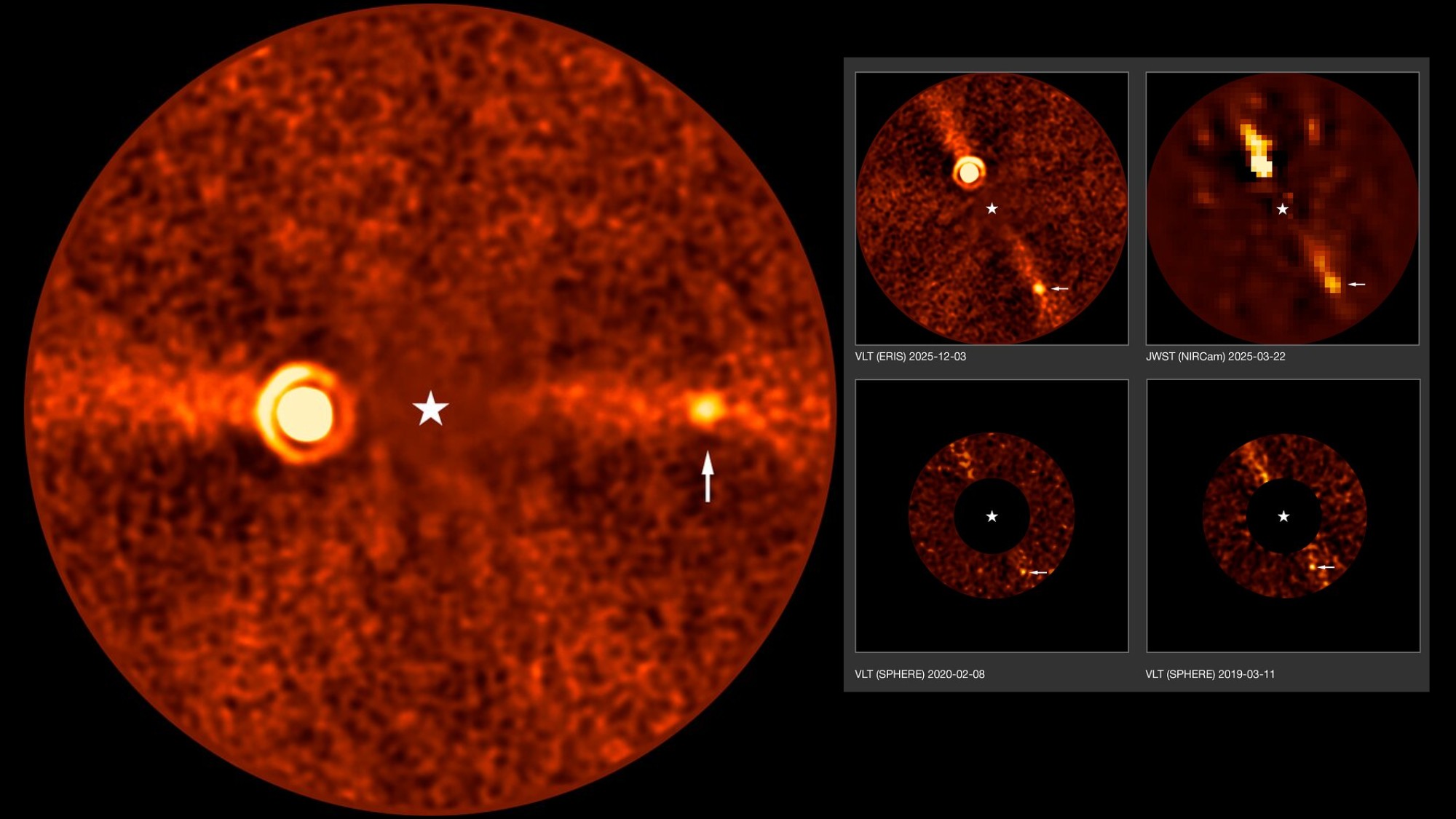
Found you.
After a decade of looking, astronomers have finally cornered a planet hiding near the star Beta Pictoris It is named Beta Pictoris d. This discovery ends an 11-year game of cosmic hide-and-seok that involved more than just bad luck. The world sits 63 light-years from Earth. It has two known siblings, Beta Pictoris b and c, which were spotted long ago. But this one stayed quiet.
“Planet d, it seems, has playing a game of hide-and-s seek with us for over a decade,” says Jayne Birk an Oxford astronomer “Now we can say ‘found you!'”
This planet is tiny by comparison. It is 100 times dimmer than its brother, Beta Pictoris b. That makes Beta Pictorus d the faintest extrasolar world ever directly imaged from ground telescopes on Earth. Direct imaging is hard. It involves picking out the tiny thermal glow of a rock or gas ball against the blinding glare of a star. Out of NASA’s 6,000+ confirmed exoplanets, fewer than 100 have been seen this way.
Beta Pictoris d isn’t just dim. It’s lighter too. The other two siblings each carry about 10 Jupiter masses. Beta Pictoris d? Only about 2.4 Jupiter masses. It is a gas giant, but a cool one. Its distance from the parent star keeps temperatures low. It is one of the lightest planets we have managed to capture directly.
A puzzle solved
The discovery wasn’t planned.
Ben Sutlieff a University of Edinburgh astronomer led the hunt. They weren’t looking for a new world initially. They just wanted to watch Beta Pictoris b change over time. Serendipity struck instead. While analyzing the data, signs of another world emerged. So the team went digging into 11 years of archives. The planet was there. All along. Lurking in old images.
This find does more than boost records. It explains a mess.
The Beta Pictoris system has a disk of dust and debris. Astronomers thought this material was leftover from planet formation. The disk’s shape was weird. Its location made no sense until now. Beta Pictoris d has exactly the right mass. It is in the exact right spot. It gravitationally explains the debris distribution.
Rare company
We should remember how unusual this is.
Direct imaging remains tricky. Faintness is a killer for telescopes. Beta Pictorus b is famous partly because it is bright. D is faint. Catching it is a massive technical step forward.
“This makes Beta Pictoris just the second system with more than two directly imaged worlds,” notes Sutlieff. The first? HR 8799. A triple system 133 light-years distant.
Multiple directly imaged planets in one system are the holy grails of discovery. Why? Because they share the same nursery. We can compare them. We can see what happens when worlds form side by side in similar conditions.
Does a third sibling make a family dynamic interesting? Yes. It helps us understand formation environments. Beta Pictoris is becoming a key textbook example.
We stared at the data for eleven years. It hid. Then it showed us. What else is hiding in plain sight? Maybe right now, another faint world waits. Waiting for a telescope powerful enough. Or lucky enough.
The sky is big. Our instruments get better. The game continues.