
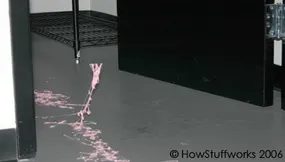
In December 2006, the war in Iraq took a strange turn. American and British troops stopped relying solely on high-tech sensors to clear buildings. They started using a party favor. They sprayed Silly String down corridors and through doorways. If a tripwire was present, the bright plastic strands would catch on it, revealing the deadly trap before anyone stepped on it.
Suddenly, a cheap toy became a survival tool.
The story made the rounds online. It raised questions that seemed too simple to have complex answers. How does a pressurized can release hundreds of feet of solid material? Why doesn’t the string break when it hits a thin wire? And who actually made the formula that could stop an explosion?
The internet had a ready answer. Or so it thought.
Websites claimed the secret was locked tight. They said chemists were stumped. They argued that the manufacturer guarded the formula like a state secret. But there was one fact everyone agreed on. Julius Samann introduced Silly String to the world in 1969.
That date is correct. The rest is mostly fiction.
The Myth of the Impossible Formula
Most sources treat Silly String as a chemical mystery. They say it is a non-Newtonian fluid. They claim the ingredients are so proprietary that no outside scientist could replicate them. This narrative is convenient. It makes the product seem magical. It also keeps the average consumer from asking the right questions.
The truth is far more mundane. And far more interesting.
Julius Samann was not a chemist. He was a salesman. His company, Saman Industries, bought the rights to a product called “Silly String” from a defunct manufacturer. Samann didn’t invent the chemistry. He invented the marketing. And the marketing was so effective that people forgot how simple the mechanism actually was.
The Science of the Spray
Let’s look at the physics. A can of Silly String contains a propellant and a polymer solution. The propellant is usually a compressed gas. When you press the nozzle, the pressure drops. The liquid expands rapidly.
This is not magic. It is thermodynamics.
The polymer is a long-chain molecule. It is dissolved in the solvent. As it exits the can, the solvent evaporates almost instantly. The polymer hardens into a solid strand before it hits the ground. That is why it flies so far. It is lightweight. It is aerodynamic. And it is dry by the time it lands.
Some sources say the string is designed to loop over wires. It isn’t. It just gets stuck. The texture of the hardened polymer is rough. It catches on surfaces. If a wire is there, the string wraps around it. If there is no wire, the string just falls in a pile.
Who Actually Invented It?
Julius Samann is the name on the can. But he did not create the original formula.
In the late 1950s, a company called Bradley Products in Indiana created a similar product. They called it “Silly String.” It was a novelty item. It sold poorly. The company went under.
Samann bought the rights in 1966. He rebranded it. He marketed it aggressively. He added the
The Real Inventors of Silly String
Forget the internet lore. A 1972 United States Patent for a “foamable resinous composition” has a different story to tell. It describes an aerosol liquid that sprays out as a slightly tacky string. That is Silly String. The inventors listed? Robert P. Cox and Leonard A. Fish.
The United States Patent and Trademark Office (USPTO) assigned the patent to Wham-O. You know the name. They made the Hula Hoop. They made the Frisbee. Wham-O’s own website confirms this timeline. They introduced the product in 1972.
Julius Samann is absent from the original paperwork. A search of U.S. patents since 1790 shows his name on exactly two documents. Both are for containers for volatile substances. The substances are perfumes. The containers are cardboard cutouts. One looks like a fir tree. The other is a woman in a state of undress.
So why does every site claim Samann invented Silly String? The answer lies in later rights transfers. In 1999, Wham-O assigned the Silly String trademark to Julius Samann, Ltd. This company owns Car-freshner Corporation. Car-freshner makes those dangling fragrant trees. Its toy division, Just for Kicks, now manufactures Silly String. Other brands make similar products too. Names like Fun Streamer and Crazy String exist.
Despite the confusion, the product isn’t a mystery. The way it flies. The way it clings. It all comes down to ingredient interactions. We will break down how ordinary chemicals become extraordinary liquid string next.
Tracing the Trademark Timeline
Wham-O’s history timeline places the introduction of Silly String in 1972. The USPTO trademark records for the logo tell a slightly different story. The application lists first use of the logo as August 6, 1969.